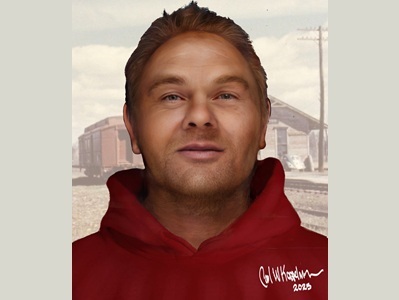
Credit: Carl Koppelman via DDP
On Dec. 16, 2003, the body of a man was discovered in a rail car in a yard in Minneapolis, Minnesota. The train had traveled to Minneapolis from Chicago, Illinois, stopping along the way in Portage, Wisconsin. Now, thanks to the application of investigative genetic genealogy, new information has been revealed in the cold case of Minneapolis Rail Car John Doe 2003. Additionally, a new facial reconstruction has been created by renowned forensic artist Carl Koppelman to show what he may have looked like.
Previously, it was estimated that the unidentified man was 30-45 years old at the time of his death, which occurred just hours before he was found. He had blue eyes and brown, thinning hair, along with a beard and a mustache. He was approximately 5’8” and weighed 131 pounds. It was also noted that he had several missing teeth and a fractured crown, along with a smallpox vaccination scar on his upper right arm.
The Hennepin County Medical Examiner’s Office later brought this case to the DNA Doe Project, whose expert investigative genetic genealogists work pro bono to identify John and Jane Does, but efforts to identify this man have been complicated by a lack of DNA matches.
However, our research has now led to a significant development. We now know that Minneapolis Rail Car John Doe is of Polish heritage, with strong ties to Boronów, Silesian Voivodeship. It’s possible that he was originally from Poland, but it’s also possible that he was born and raised in the US to a family with Polish roots.
Furthermore, the team on this case has discovered a number of families that this man has connections to. Surnames that appear in his family tree include Broll, Burejza, Kucharczyk, Polck/Polk, Sowa, Swiertz/Świercz, and Ulfik.
In order to uncover his identity, the DNA Doe Project is asking for the public’s assistance, especially from people with Polish heritage. If you’ve taken a consumer DNA test, you can upload your DNA data to the databases we have access to for our work – GEDmatch, DNA Justice and FamilyTreeDNA. We’ll then be able to see if you share DNA with this man – if you do, we’ll know that you’re a relative of his, and this could lead us to his identity. Even if you’re only a distant relative, this might still help us – a single match is often all it takes to crack a cold case.
“This case is challenging because people of Polish descent are underrepresented in the DNA databases we have access to,” said team co-leader Daphne Solberg. “If more people upload their DNA profiles to GEDmatch, DNA Justice, and FamilyTreeDNA, the likelier we are to identify this man.”
Republished courtesy of DNA Doe Project