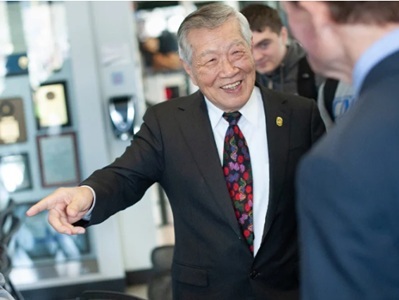
Dr. Lee was a favorite of students and alumni, regularly appearing at events on campus. Credit: UNH
World-renowned forensics scientist Henry C. Lee passed away peacefully on Friday, March 27, 2026 at his home in Henderson, Nevada, displaying remarkable strength, grace and resilience during a brief illness. He was 87 years old. His passing was announced by his family, in conjunction with the University of New Haven, where he served as a distinguished professor for more than 50 years.
In his final days, Lee was finalizing a book regarding missing-persons investigations, which will be published in the near future. He has authored or co-authored more than 40 books.
Lee joined the University of New Haven in 1975 and founded the University’s forensic science program, developing it from a small classroom equipped with a single fingerprint kit into an internationally recognized multi-disciplined academic department considered one of the nation’s best.
In 1998, he founded the Henry C. Lee Institute of Forensic Science, and, in 2010, the University opened an ultra-modern home for the institute, a three-story, 15,000 square-foot facility featuring the most cutting-edge forensics investigation technology, including a crime scene center, a high-tech forensic room, a crisis management center, and a state-of-the-art learning center. "The Institute will become a catalyst enabling professionals in the field to work together," Dr. Lee said at its unveiling. "The world then becomes a small community engaged in fighting crime.".
For more than 20 years while at the University of New Haven, Lee served as chief criminalist for the State of Connecticut and director of the Connecticut State Police Forensic Science Laboratory from 1978 to 2000 and was Commissioner of the state’s Department of Public Safety and Connecticut State Police from 1998-2000. He was Chief Emeritus for the state of Connecticut’s Division of Scientific Services from 2000 to 2010.
"What he has done has changed the face of forensic knowledge among police officers and other criminal justice professionals," Mary Galvin, a retired Connecticut State’s attorney, told the New York Times in 2000, as he concluded his time as Commissioner for Connecticut’s Department of Public Safety.
"Dr. Lee was a remarkable individual," said University of New Haven President Jens Frederiksen. "His contributions to our University as well as forensic science and law enforcement are extraordinary and unmatched. His legacy lives on in the generations of students and law enforcement professionals he impacted throughout his brilliant career. We send our deepest condolences to his family and those mourning his passing."
Throughout his legendary career, Dr. Lee has served as a forensics expert in all 50 states and more than 46 countries, and has lectured in more than 70 countries. He has been a consultant for 600 law enforcement agencies and has testified more than 1,000 times in both criminal and civil courts in the United States and abroad, most notably in the O.J. Simpson case. For some of the highest-profile cases, Dr. Lee provided investigative assistance, including the murder of JonBenét Ramsey, the Helle Crafts woodchipper murder, the Laci Peterson case, the death of Chandra Levy, the kidnapping of Elizabeth Smart, 9/11 forensics investigation, and the reinvestigation of the John F. Kennedy assassination.
He hosted a crime-documentary series in 2004 on then Court TV titled, "Trace Evidence: The Case Files of Dr. Henry Lee."
Lee was born November 22, 1938, in Rugao, Jiangsu, China, where a multi-story museum stands in his honor. His family emigrated to Taiwan where he received a Bachelor of Arts degree in police administration from the Central Police College in 1960. He became a police officer in the Taipei Police Department, rising to captain at the age of 22, the youngest in Taiwanese history.
Lee moved with his late wife to the United States in 1964. Lee earned his Ph.D. (1975) and master’s (1974) degrees in biochemistry from New York University, and a bachelor’s degree in forensic science from John Jay College (1972). Lee has been conferred 30 honorary degrees, including from the University of New Haven in 1991 and 2010. Dr. Lee was an emeritus member of the University’s Board of Governors for nearly 30 years.
He gave the Commencement address at the University’s 1991 Winter Commencement and its Spring Commencement in 2025, when he told graduates, "You must also understand the importance of positive thinking. There is no obstacle that cannot be overcome if you persist and believe." Lee’s slogan was: "Make the impossible possible."
Lee was pre-deceased by his wife Margaret Lee in 2017. He is survived by his daughter Sherry Hersey and son Stanley Lee, their respective spouses, Ted and Romy, and their four grandchildren, David Hersey and Rachel Hersey Hotaj, and Joseph and Alexander Lee, as well as his wife Angel Xiaping Jiang and her sons Yan Liu and Tianchen Liu.
The eleventh of 13 children, Lee credited his sister Dr. Sylvia Lee-Huang for supporting him throughout his studies and his career. Lee recently said, "Without the support of Dr. Sylvia Lee-Huang, there would be no Dr. Henry Lee."
Committed to giving back, he had contributed his speaking honoraria and major gifts over the years. Ever humble, he did not want a memorial or celebration of life.
Republished courtesy of University of New Haven