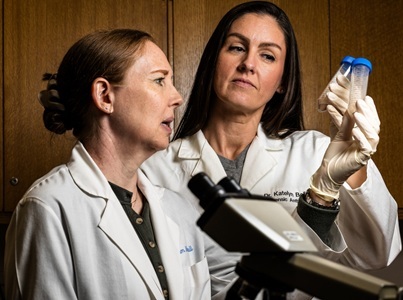
Pamela Marshall (left) and Katelyn Bolhofner pose with soil samples in one of their labs, Credit: Charlie Leight/ASU News
It is not uncommon for a body to be moved after a murder, usually to hide or eliminate evidence. And while the Arizona desert may seem like the perfect place to commit such a crime, a new study shows that a cadaver can still leave behind critical clues even in that harsh environment.
“A lot of times a murderer will kill someone and put the body somewhere, stash it, panic and then move it. How can you ever trace where they have done this?” said lead study author Katelyn Bolhofner, assistant professor of forensics at Arizona State University.
During their study, Bolhofner and team discovered the answer to this question is microbial fingerprints.
Signature of death
Published in Journal of Forensic Sciences, the study used two 200-pound pig models dressed in jeans and a button-up shirt to closely mimic how murder victims are commonly clothed.
The pigs were then left to decompose in large cages (to keep scavenging animals away) in various environments and seasons in the Sonoran Desert.
After 25 days, the remains were moved to a secondary burial location. Then, over a period of nine months, the researchers tested the soil where the model was originally placed, where it was moved and in a location adjacent to the original burial as a control.
According to the study results, the researchers found distinct microbial fingerprints where death gave way to new life—bacteria and fungi that once lived inside or on the body and were released into the surrounding ground as decomposition occurred.
“It turned out to be a really crazy finding,” said Bolhofner said. “It’s like the murder victim is leaving a signature of themselves in death … almost like leaving breadcrumbs right around the desert (indicating) that they had been there, and those breadcrumbs stayed in the soil, invisible to the naked eye for a year.”
More and future studies
According to the World Population Review, Arizona has one of the highest number of missing persons in the nation—with more than 1,000 people missing and 1,588 resolved cases in 2025.
Stuart Somershoe, a retired police detective with the Phoenix Police Department’s missing persons division who was a part of the project, says the desert certainly plays into those statistics.
Somershoe also said that as this research develops and becomes more well-known, it could become a technique as commonly used as DNA testing. But first, more experiments and studies will be needed.
Bolhofner and team confirmed they are interested in taking the study on the road to see if the findings can be confirmed in other climates.
“This study is really specific to this climate and this landscape and this geography. Our soil and our climate are so harsh and so odd. The fact that this can be proven here should show that in other climates, it's much more doable. Those climates are much friendlier,” said study co-author Pam Marshall, from the School of Mathematical and Natural Sciences.
The researchers also plan to verify that human remains would yield similar results.
“We need to figure out how what we have discovered is transferable,” said Marshall.