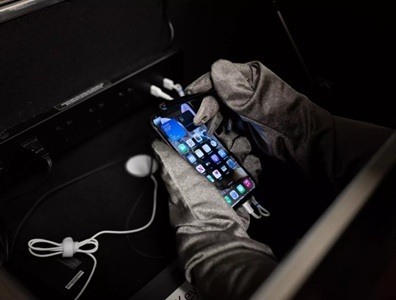
Students Kennedy Clark and Marissa Parcell work as interns at the IUPD Digital Forensics Unit. Credit: Liz Kaye/Indiana University
The rapid expansion of digital technology in the 21st century has delivered some of history’s greatest inventions, but for the millions of victims of cybercrime, it’s also been met with plenty of drawbacks.
According to 2024 estimates from Statista’s Market Insights, the global cost of cybercrime is expected to reach $15.63 trillion by 2029, more than quadrupling costs from 2020. With governments, companies and everyday people taking increased measures to protect against cyber criminals, an important new career field is starting to take root.
This fall, the IU School of Science at IU Indianapolis started offering a Bachelor of Science degree in digital forensics, a field the Bureau of Labor Statistics estimates to grow 33% by 2033.
“I’m very excited to expand our program and I think this will be a great thing for IU Indianapolis, our state and our school,” Gina Londino-Smolar, director of the Forensic and Investigative Sciences program at the School of Science, said. “With the way artificial intelligence has infiltrated many aspects of our lives, there’s a clear indication we as a society are going to rely so much more on computers and digital information. We’re finding crime is also moving into that realm as well, making the field of digital forensics vital moving forward.”
Receiving an educational background in both computer and forensic science, students pursuing a degree in digital forensics will have the opportunity to get valuable hands-on experience in how digital evidence is analyzed in the court of law and how it aids in an investigation, whether it be civil or criminal.
While in the classroom, they’ll learn principles and practices within computer science, ethics, quality assurance, law, the criminal justice system and more.
“We’re very fortunate to have great colleagues over in Luddy,” Londino-Smolar said. “We were able to work with them in building a curriculum they thought most appropriate for students pursuing a degree in digital forensics. Through this program, it should be easy for students to obtain a dual degree, creating a great benefit for students from both schools.”
From a career perspective, graduates of the digital forensics program will be capable of serving within state or federal crime labs, helping bring justice to local communities. There’s also a heavy demand within the private sector for those looking to protect business, employees and consumers.
For some, it could mean a role within theft and prevention, for others, it could mean something a little more serious, like analyzing counterfeit drugs or combatting cyberattacks where hackers are trying to steal confidential data.
“There’s a lot of opportunity with this degree, especially in settings we wouldn’t traditionally think of forensic science,” Londino-Smolar said. “In the private sector, even if you don’t think they’d have forensic type of position, they do. Places like Eli Lilly have a forensic unit that looks at counterfeit pills that people might be making and do their own investigations. Same thing with a place like Target, who also has their own forensic unit looking at theft, shoplifting and things like that.”
One defining factor Londino-Smolar points to with this program is its availability. There are plenty of computer-based forensics program offerings across the country, but the overwhelming majority of them are on the graduate level. In fact, on the bachelor level, there’s currently only one digital forensics program that’s accredited through the Forensic Science Education Programs Accreditation Commission (FEPAC).
Both the bachelor’s and master’s programs in forensic and investigative sciences at the School of Science are FEPAC accredited, making IU Indianapolis one of only 53 universities with an accredited forensics program. The goal is to ensure the digital forensics program earns accreditation as well.
“With our other programs already being FEPAC accredited, we’re really hoping that once we get those two graduating classes with this degree, we’ll be able to apply for that accreditation,” Londino-Smolar said. “With there only being one other FEPAC program accredited in digital forensics at the bachelors level, it’ll be something that further sets us apart.”
Students interested in the digital forensics program can learn more by visiting the degree’s webpage or contacting Londino-Smolar.
Republished courtesy of Indiana University Indianapolis