Credit: WCU
On a cold morning in December 2025, six forensic anthropology students from Western Carolina University entered the woods of Ellerbe Creek with five of their professors and a group of Durham Police Department officials.
They combed the wilderness in a long line, slowly and methodically, searching for what small clues the forest floor kept. A piece of plastic. A length of fabric. What might’ve been trash on another day, but now presented as evidence.
It took hours, block by block on an expansive grid, until a somber moment of discovery broke their rote, when Kayleigh Best, director of the forensic anthropology program, discovered the remains of an individual Durham Police investigators had been searching for since 2023.
“Due to the assistance by everyone involved from WCU, we can bring closure to the family of the deceased, as well as clear a case, and obtain valuable experience in these types of cases,” said Donald Hall, investigator with the Durham Police Department (DPD). “WCU allowing staff and students to conduct these types of searches and investigations greatly assists law enforcement in locating additional remains. I can tell you from personal experience, the Durham Police Department would not have located these remains without the assistance and experience of Western Carolina University.
To incite the closure of such a case, to be directly involved in it, is a rare privilege, an act of service that career professionals aspire to. To experience it as a student is an even more unique opportunity, and one among many orchestrated by the faculty of WCU’s forensic anthropology department.
After all, it’s not the first investigation WCU students have helped with, and it’s just one way students are learning now how they can serve their community as human scientists.
Above and beyond forensic classes
“In all of our classes we try to give students the education training that they would need if they chose to go on to do forensic anthropology or into related fields, like law enforcement or medical examining or the forensic sciences. We have students that go into bioarcheology, that work in the funeral industry, that work in the medical field. So, we have a broad diversity of interests in the program, but we also do a lot of hands-on labs," said Best.
With such a wide variety of research scenarios available, students of the program are meant to be able to get comfortable with the multidisciplinary nature of their field while exploring at their own pace. And their explorations go far and wide, from the common standards of police and evidence work to the brink of scientific study.
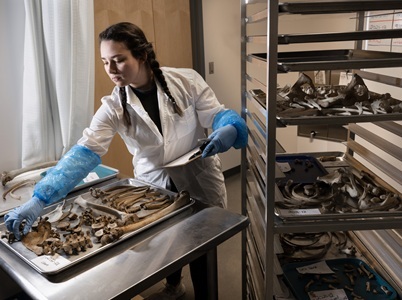
WCU retains a large collection of skeletons, used for research across the globe, that current students are studying to theorize new ways skeleton elements can reveal the identities of the deceased.
At its taphonomic research facility, the second oldest in the entire world and colloquially dubbed the “body farm,” young scientists are examining the decay of organic matter over different times and different circumstances, broadening our understanding of how the human body changes after death to microscopic levels.
The hundreds of hours of volunteer work also available to Catamounts in the program aims to instill that most crucial understanding that at the end of the day, forensic anthropology is about service.
“Forensic anthropology is there to help support the community in a lot of different ways, and in this particular case, we are helping our students who are in our community here at Western and their families, but also the much larger community around us, the state of North Carolina, cities in North Carolina, law enforcement communities – all of that,” Best said.
“I think this speaks to the power and impact that forensic anthropology can have," said senior student Tayler Franklin, who is double majoring in forensic science and forensic anthropology. "Being able to participate in the search this past December was an incredible, yet humbling, experience for me. I feel very honored that I was able to assist with such an endeavor, especially considering that the search was a successful one. Through the Forensic Anthropology program at WCU, I have been lucky enough to discover what I feel is my calling in life: to bring families closure and peace of mind in times of death and uncertainty."
Republished courtesy of Western Carolina University