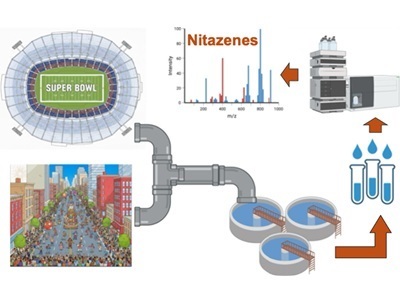
Adapted from: DOI: 10.1021/acs.estlett.6c00010
For the first time, researchers have used real-time wastewater monitoring to track nitazene compounds in municipal wastewater.
Wastewater-based epidemiology has been used to in the past for early detection of illicit drugs like cocaine and methamphetamine. More recently, the non-invasive method was employed during the COVID-19 pandemic to detect surges in specific cities. It has also been used for other worrisome diseases, like polio.
Nitazenes were first synthesized in the 1950s by pharmaceutical laboratories to develop alternative medications for morphine; however, their therapeutic use was not approved by the U.S. Food and Drug Administration (FDA) due to their high potential for overdose casualties. After 60 years, nitazenes re-emerged in the illegal drug supply chain in 2019—and have been increasing in use since.
Despite this accelerating trend reported by the National Forensic Laboratory Information System since 2019, traditional approaches, constrained analytical capabilities and logistical challenges often delay timely forensic reporting. For example, despite opioids accounting for 46% of the 2,456 overdose deaths in Louisiana in 2023, there were no reported cases of nitazene-involved overdose deaths.
Last year, with Super Bowl LIX and Mardi Gras planned in New Orleans within one month of each other, researchers saw a perfect opportunity to employ a new wastewater monitoring method specific to nitazenes. A team from Louisiana State University developed and validated an analytical method capable of nearly real-time quantification of several nitazenes in wastewater samples.
Detection and quantification
For the study, published in ACS’s Environmental Science & Technology Letters, the researchers focused on the period surrounding and including the Super Bowl and Mardi Gras—from Jan. 23 to March 31, 2025. They collected 28 samples from a treatment plant estimated to serve nearly 300,000 people.
The analyses detected seven of the nine nitazenes down to trace levels in wastewater.
The most frequently detected nitazene was metonitazene, seen most often in samples collected during the week of the Super Bowl and the week of Mardi Gras, as opposed to the weeks before and after. N-pyrrolidino etonitazene, isotonitazene, butonitazene, and etonitazene were the next commonly detected.
Multiple nitazenes were also identified on a typical week in New Orleans after Mardi Gras at a similar detection frequency as the Super Bowl and Mardi Gras. Interestingly, protonitazene and N-pyrrolidino protonitazene were quantified only after Mardi Gras.
Of the nine target nitazenes, N-pyrrolidino metonitazene and N-pyrrolidino isotonitazene were not detected in any collected samples.
These estimates do not provide insight into the consumption rate of nitazene analogues because the excretion rates of these drugs must be understood first. However, early detection of these substances is incredibly important, especially during high-traffic events.
“Our study reveals the growing trend of synthetic opioid use in communities and our non-invasive approach to detect these emerging drugs,” said co-authors Ramesh Sapkota and Emilia Lomnicki. “With this knowledge, valuable insight into the evolving dynamics of the overdose crisis is gained, and a discussion on public health responses to combat these illicit drugs and prevent further loss of life is opened.”