Credit: DDP
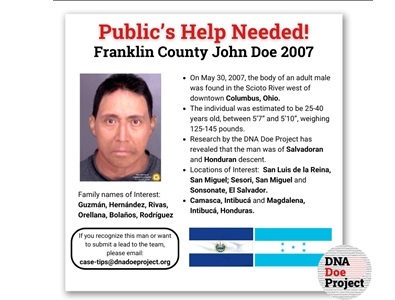
In 2007, a fisherman saw the body of a man floating down the Scioto River in Columbus, Ohio. This man had no identification on him, and in the eighteen years since he was discovered, no one has come forward to identify him. Now, thanks to the application of investigative genetic genealogy, new information has been revealed in the cold case of Franklin County John Doe 2007.
In 2022, the Franklin County Coroner’s Office brought this case to the DNA Doe Project, whose expert volunteer investigative genetic genealogists work pro bono to identify John and Jane Does. Efforts to identify the man have been complicated by a lack of DNA matches and the inaccessibility of records, but the team working on this case have now identified a number of locations and families that Franklin County John Doe has links to.
It appears that the unidentified man has roots in El Salvador and Honduras, and it’s possible that he moved to the US from one of these countries. In El Salvador, he has ties to the districts of San Luis de la Reina and Sesori in the department of San Miguel. In Honduras, he has ties to the districts of Camasca and Magdalena in the department of Intibucá.
Furthermore, the team on this case have discovered a number of families from these areas who the unidentified man has connections to. Surnames that appear in his family tree include Guzmán, Hernández, Orellana, Bolaños, Rivas and Rodríguez.
To uncover the identity of Franklin County John Doe, the DNA Doe Project is asking for the public’s assistance. People are encouraged to get in touch if they know of a man who hasn’t been heard from since 2007 and who has connections to one of these areas or surnames. They can either contact the Franklin County Coroner’s Office to share a tip or contact the DNA Doe Project directly at [email protected].
“My office is responsible for identifying any person who is found dead in our jurisdiction,” said Nate Overmire, the Franklin County Coroner. “We put ourselves in the situation, as if we lost a loved one. Our goal is to connect unidentified individuals with their loved ones so they can have closure.”
Members of the public can also help us solve this case in a different way, especially if they have roots in the regions of San Miguel, El Salvador or Intibucá, Honduras. Anyone who’s taken a consumer DNA test can upload it to the databases we have access to for our work - GEDmatch, DNA Justice and FamilyTreeDNA. Then, if they share DNA with the unidentified man, we’ll know that they’re a relative of his and this could lead us to his identity. Even if they’re only a distant relative, this still might help us - a single match is often all it takes to crack a cold case.
Republished courtesy of DNA Doe Project