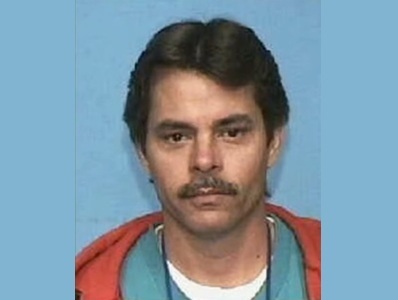
Mug shot of suspected serial killer Robert Eugene Brashers
In September 2025, Austin police announced they had finally identified the man responsible for assaulting and murdering four teenagers in 1991—a case that would go on to be called the “yogurt shop murders.”
The big break came when an Austin detective re-tested the .380 shell casing recovered from the yogurt shop—the only physical evidence. In a matter of hours, the detective was notified of a “hit” to an unsolved 1998 murder in Kentucky. Further investigation revealed a match of the suspect’s Y-STR profile to another unsolved murder in South Carolina.
Back in Austin, the lab confirmed Robert Eugene Brashers’ Y-STR profile in the sexual assault kits of the four teenagers. The lab also retested the fingernail clippings of one of the girls and generated an STR profile. That STR profile was compared directly to Brashers—and matched. At this time, DNA from the 1998 unsolved Kentucky murder was also directly compared with Brashers and he cannot be excluded as the perpetrator.
On Wednesday, DNA analysis completed by DNA Labs International using evidence from the Kentucky victim’s post-mortem sexual assault kit confirmed what was expected—43-year-old Linda Rutledge was another victim of Brashers. The serial killer has now been connected to eight murders, although police suspect there are more.
The Kentucky murder
On Nov. 7, 1998, around 7:40 am, the Lexington Fire Department was dispatched to the Nixon Hearing Aid Center for a structure fire. Once the fire was extinguished, the crew located a female victim deceased in the back hallway.
An autopsy identified the victim as 43-year-old Linda Marie Rutledge. Her cause of death was determined to be multiple gunshot wounds to the head, with noted injuries from blunt force trauma. Additionally, a sexual assault kit was performed on the suspicion of rape.
Retired police commander Anne Witte said a lot of evidence was collected and preserved from the 1998 crime scene, including whole door frames, door handles and other fire debris. One specific piece of evidence, though, ended up being the key to solving the crime—a .380 spent shell casing.
In June 2025, Lexington Police Department Detective John Davis began reviewing the cold case file again to see if any steps could be taken with new technology. Then, on July 4, the Austin Police Department reached out to him about a potential shell casing match to their infamous yogurt shop murders.
The yogurt shop murders and the Kentucky murder shared some aspects, most noticeably the fire. In that case, all four girls in the yogurt shop were found nude and bound, shot in the head execution style with a .22 caliber bullet. Three girls—Sarah, Eliza and Jennifer—were severely charred due to the fire. However, Amy's body was found in a separate part of the yogurt shop. She was not charred, but had burns on 25–30% of her body. Amy had been shot in the same way as the others; however, the bullet had missed her brain. She was then shot a second time with a different firearm—a .380. As intended, the fire that Brashers allegedly set after the murders made evidence collection extremely difficult.
“The fire department took great pains to preserve the scene [of Rutledge’s] murder,” said Witte. “It took 27 years, but because of their efforts to preserve evidence, we were able to do something with that evidence this long after the case.”
Even more evidence
Further investigation of Rutledge’s murder, now with the context from the yogurt shop murders, revealed even more. Not only was the Kentucky State Forensic Lab able to determine the same .380 firearm was used for all five murders, but they also concluded the projectiles collected from the Kentucky scene came from the same firearm as well.
Then, DNA Labs International analyzed Rutledge’s rape kit and, within a week, generated a profile that matched the DNA profile of Brashers from the yogurt ship murders case.
This gave the Lexington Police Department all they needed to tie Brashers to Rutledge’s murder. If he was alive today, he would be arrested. But, Brashers died by suicide on Jan. 13, 1999, in Kennett, Missouri. As per his MO, he had two guns on him but chose the same .380 firearm that he used in both the yogurt shop murders and the murder of Linda Rutledge.
Brashers has now been connected to eight murders, in addition to one attempted murder and two additional sexual assaults across Florida, South Carolina, Texas, Tennessee, Missouri and now Kentucky.