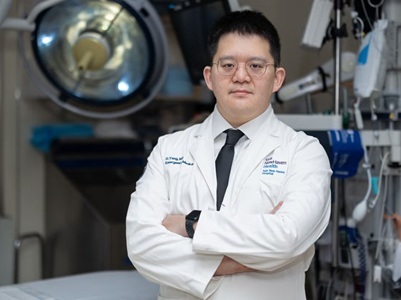
David Yang took care of numerous survivors of sexual assault in the emergency department (ED). Credit: Dan Renzetti
Every 74 seconds, someone in the United States is sexually assaulted. Emergency departments are often the first point of care for survivors after being assaulted. Recommended care includes addressing the immediate physical and psychological needs of the survivor, conducting a forensic examination, and offering a sexual assault victim advocate to the survivor. However, adherence to this care in the emergency department is low.
Emergency departments are often packed and struggling for resources. Additionally, there is a shortage of Sexual Assault Nurse Examiners (SANE) who are certified to conduct a medical forensic examination, collect evidence, provide medical care and emotional support, and collaborate with law enforcement.
When David Yang was a resident at Yale New Haven Hospital, he took care of numerous survivors of sexual assault in the emergency department—and noticed the struggles and discrepancies. In an effort to improve care, Yang created a new clinical decision support (CDS) tool that has already led to improved medical and forensic care of sexual assault survivors.
The electronic health record (EHR)-integrated clinical tool combines guidelines, expert consensus, orders and resources specific to the evaluation and management of adults seeking care in the ED after sexual assault.
“Because there’s a large team involved with caring for these patients, the goal of the tool was to involve each team member early in a structured pathway that focused on providing consistent and trauma-informed management for each patient,” said Yang.
Yang and colleagues first implemented the tool in a large health system in southeast Connecticut on July 13, 2021. They then reviewed medical charts of 552 adult survivors of sexual assault—covering the period between Jan. 1, 2020, and Dec. 31, 2022—to understand the quality of care before and after implementation.
The researchers then measured the quality of care using six key outcomes. The two non-clinical outcomes included the number of patients who had been offered consultation with a sexual assault advocate, and the number of sexual assault forensic evidence kits collected within 120 hours of assault. The four clinical outcomes included pregnancy tests ordered, emergency contraception ordered, HIV postexposure prophylaxis ordered within 72 hours of assault, and sexually transmitted infection prophylaxis ordered.
According to the study results published in Academic Emergency Medicine, the team found that patients’ medical and forensic care improved when physicians used the tool—which ultimately amounted to 51% of the time after it was implemented.
“Because an individual physician will only see a handful of these patients annually, we thought an on-shift resource would be useful to improve their care so that we could streamline care and so physicians could see when each treatment was indicated so that we could maximize adherence to recommended care,” Yang said.
These findings, they say, mark a vital step forward in optimizing care for sexual assault survivors—and has the potential to influence clinical practice and inform policies to improve care moving forward.
In addition to the new study, Yang also recently co-authored a position paper in the journal Prehospital Emergency Care to guide emergency medical service agencies and clinicians in the patient-centered management of survivors of sexual assault. The recommendations include trauma-informed care, assessing physical injuries after sexual assault, collaboration with sexual assault forensic examiner organizations, documentation, and more.