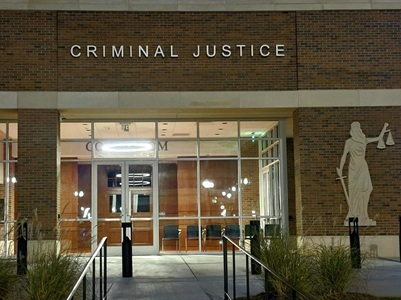
New Criminal Justice Building. Credit: Sambhav Pyakurel
Sarah Cantrell’s first visit to the anthropology lab in Walker Science Building wasn’t what she expected. Surrounded by real human bones, the junior majoring in Crime Scene Investigation learned to determine gender, ethnicity and age from skeletal remains—skills that would have seemed impossible before arriving at the University of Southern Mississippi.
“It’s very different, but it’s so interesting,” Cantrell said, reflecting on the hands-on experience that defines USM’s approach to forensic education.
This fall, USM launched a restructured forensic science major: Crime Scene Investigation, becoming Mississippi’s only institution offering such a specialized program. The change reflects a broader transformation in how the university prepares students for careers in forensic science—moving away from glamorized television portrayals toward the tedious, detail-oriented reality of actual crime scene work.
Kristi Johnson, a forensic science instructor at the School of Criminal Justice, Forensic Science and Security who spent 12 years as a crime scene investigator at a coastal agency, knows firsthand the gap between TV and reality.
“The ‘CSI effect’ does impact students,” Johnson explained. “They come in with an understanding of the field from television, but it’s not always real or accurate.”
The program now begins with a survey course that confronts these misconceptions. Students are introduced to all components of forensic science, but more importantly, the course emphasizes how real-life forensics differs from what’s seen on TV.
Cantrell experienced the CSI effect herself.
“A lot of these shows like NCIS show how quickly they get results back from forensic testing. In reality, it could take months to get one result back. This is a very tedious major because CSI is not just science—it’s law, it’s networking.”
USM’s Crime Scene Investigation program emphasizes practical learning. Students gain hands-on experience with various components of forensic science, including crime scene sketching, measurement collection, photography, and evidence handling. The courses prepare students for other forensic disciplines that can be applied to fieldwork, like the fingerprint analysis course, where students learn to process items of evidence for fingerprints. The university also has a fingerprint database where students can simulate comparison processes.
“They are learning everything from assessing, securing, documenting, collecting—all the major crime scene processing duties,” said Johnson. “There are a lot of different options for students to tailor their academic goals to meet their career goals and prepare them for their future roles as field practitioners in forensic science.”
In Cantrell’s forensic science lab, she’s learning to cast footwear impressions using dental stone, photograph scenes properly, and handle firearms without contamination. She’s also mastering serology tests for blood evidence and studying the intricacies of DNA analysis.
“This major is a mixture of every subject,” Cantrell said. “It's just so much, but it's so interesting.”
In the classroom, students learn the law and ethics side of the course. The criminal justice and ethics class Cantrell attends is about being ethical when doing things like search and seizure laws and understanding the Fourth Amendment. It teaches things like the chain of custody, and all the ethical ways to go about an investigation.
Beyond the classroom and laboratory work, students must also learn to manage the emotional demands of the field.
“You have to be able to disassociate yourself from what you’re looking at,” Cantrell explained. “Imagine you have a crime scene where the deceased looks just like your mother or your brother. That happens a lot.”
The university addresses this through multiple approaches. Faculty members share their own field experiences and teach healthy coping mechanisms. The program gradually introduces students to real-world scenarios, starting with case studies, photographs, and visits to the cadaver lab, where they observe actual deceased bodies.
“We introduce them to the realities of work as a forensic practitioner, which includes some things that can be difficult,” said Johnson. “We’re talking about investigating homicides, and they’re having to do things that a lot of people in different careers don’t have to do or think about.”
The student organizations, Forensic Science Society and Criminal Justice Student Association, also hold frequent talks where real-life practitioners come and share their stories and insights. Cantrell has started journaling to manage the stress that comes with the major.
Beyond classes, the university recommends students get into an internship. Though it has been removed as a requirement from the program, the university still has the internship course.
“We work very hard to place students in an internship that's going to get them that real-world practical experience before they graduate,” said Johnson. “That way, we can prepare them for the realities and the challenges of the job.”
Cantrell plans to pursue summer opportunities in Ireland through USM’s study abroad program, complementing her upcoming January trip to London for chemistry studies.
On the digital front, while the university currently doesn’t have a dedicated program in digital forensics, it’s something the school plans to incorporate soon. USM is already part of the Rural Digital Forensics Initiative — a Department of Justice–funded project that provides training materials to law enforcement agencies. The initiative will help establish a digital forensics laboratory in the university’s new criminal justice building.
“We’re eventually going to partner with other law enforcement agencies so they can use our digital processing equipment and forensics lab to help with real casework,” Johnson said.
Cantrell plans to keep building on her bachelor’s in Crime Scene Investigation and wants to go to grad school for Criminal Justice. She says, “In the long run, I want a career where I can make a difference by uncovering truth through evidence and science.”
The Crime Scene Investigation major is a new addition to USM’s other forensic programs: Forensic Chemistry and Forensic Biology.
For more information about the Crime Scene Investigation major, visit:� https://www.usm.edu/undergraduate-programs/crime-scene-investigation.php
Republished courtesy of USM