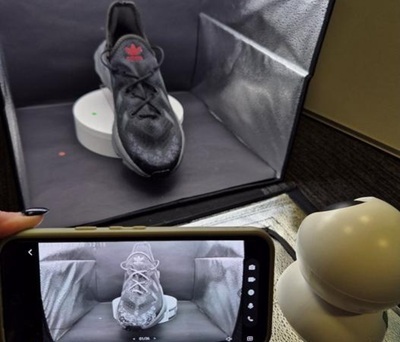
A trainer being 3D imaged. Credit: University of Staffordshire
Forensic experts are inviting the public to put their sneaker knowledge to the test – and contribute to an award-winning research project.
Led by University of Staffordshire and West Yorkshire Police, When All is Tread and Done is exploring new forensic techniques to help identify criminals by their shoes.
“While CCTV, body-worn cameras and mobile footage is increasingly used in criminal investigations, suspects often cover their faces," said project lead Claire Gwinnett. “Shoes, however, can be a distinguishing feature in CCTV footage or images and that is what our research is focussed on.”
The first phase of the project has already received national recognition, winning an award for project leadership from the Police Chief Scientific Advisor and “Innovation in Policing” at the West Yorkshire Annual Policing Awards. It is also the only initiative to receive three consecutive rounds of funding from the Police STAR Fund.
As part of this work, the team developed a fast and affordable method to capture images of sneakers under both white and infrared light to simulate CCTV conditions. These scans allow forensic experts to study the shoe upper characteristics.
Using this method, 1,000 shoes from members of the public were collected and scanned. For the final phase of the project, the team is inviting the public to participate in an online sneaker identification quiz based on these images.
Members of the public who are interested in taking this a step further also have the opportunity to participate in experiments where they will try to identify sneakers appearing in mock CCTV footage.
“This is a short, fun quiz that anybody can complete – you don’t need to be a trainer enthusiast to take part. Participants will be asked to identify makes and models of trainers, helping us to understand how people recognise specific brands and characteristics," said Gwinnett.
The ultimate aim is to roll out new technology into operational policing, providing forensic practitioners with fast, reliable tools to compare footwear seen in images to known brands.
“After three years of funded research, we have taken the idea of using footwear uppers as evidence from early-tage concept to operational reality. The next step is raising awareness — ensuring that this pioneering approach is recognised and adopted, so its full evidential value can make a difference in practice,” said Research Assistant Megan Needham.
Can you tell your Nike from your New Balance? Take the quiz now.
Republished courtesy of Staffordshire University