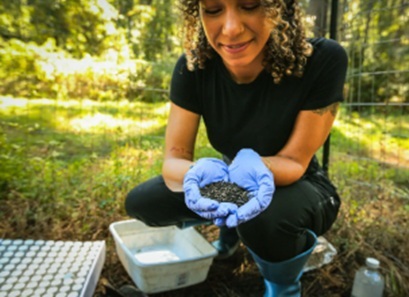
Alexa Figueroa holds a mixture of decomposing material and maggots obtained from the deceased black bear carcass, which was found by the Louisiana Department of Wildlife and Fisheries and given to the Musah lab for research. Credit: LSU
Blow flies are nature’s first responders to death. They can detect the scent of decay from nearly two kilometers away, arriving within minutes, to lay eggs. The larvae feed, grow, pupate, and finally fly away, but not without leaving behind tough, brown cases. These puparial cases can survive in the environment for years.
Flies have turned out to be excellent backup for forensic evidence, giving rise to the field of forensic entomology. The Rabi Musah Lab at Louisiana State University is taking this field a step further, using rapid analysis of the flies’ chemical signatures to make it easier than ever to collect forensic evidence from a corpse’s bugs.
“Because these flies typically arrive within 5-15 minutes of death, evidence of insect activity on the remains can help you back-calculate the post-mortem interval,” Musah said. “You can presume that fly eggs arrived on the remains within an hour of death. If you find fly larvae that are three days old, then the person has been deceased for three days, right? That is, as long as you can properly age the fly larvae.”
The problem? There are various species of blow flies, and each develops and matures at its own pace. Some take weeks to mature to adulthood, while others take just days. It’s impossible to know how old a fly egg, larva (also known as a maggot), or pupa is unless you know its species identity. And, well, “many of the eggs and maggots across species look the same,” says Musah. “Like grains of rice or squirming vanilla ice cream.”
“You can’t tell which species they belong to unless you raise the maggots to adulthood, when the different species will look different in color or wing structure, or you can sequence their DNA,” Musah said. “DNA sequencing looks good on paper, but it can be challenging to execute. It’s time-consuming, labor-intensive, requires expertise, and the results may be inconclusive. The DNA might be too degraded. Crime labs are strapped for time and resources. They’re generally not going to rear maggots or analyze their DNA.”
Because of these limitations, a lot of forensic evidence remains underutilized in crime labs.
But what if investigators could quickly and cheaply identify the insect species from the larvae, pupae, or even puparial cases? They could then estimate when the insect laid its eggs, and therefore when death occurred.
Cracking nature’s secrets with chemistry and AI
Musah’s lab has found a faster, more straightforward solution to insect identification by leaning into chemistry. Every living thing has its own chemical fingerprint — a unique mix of molecules in its body that can reveal its identity as surely as a human fingerprint does. The chemical fingerprint of a maggot can not only tell you what species of fly it is, but even what stage of development it’s in.
Musah and Alexa are currently working to build a database of chemical fingerprints for various species and life stages of blow flies. They are leveraging a technique called direct analysis in real time high-resolution mass spectrometry (DART-HRMS) to collect chemical fingerprints quickly and with no required sample preparation. All crime scene investigators will need to do is drop an insect sample into a vial of ethanol and water, send it off for a two-minute analysis, and run the result against Musah’s database.
“Running the chemical fingerprint against our database, an investigator could instantly know what insect species they are dealing with,” Musah said. “That is our hypothesis, but it has also been borne out by experiment. We've been able to demonstrate that this works for blowflies, and other insects whose job it is to facilitate decomposition, including beetles.”
In a new study published in Forensic Chemistry, Musah and collaborators used a type of mass spectrometry to analyze the chemical composition of blow fly puparial cases. The method is fast and gentle enough to preserve and detect large, unfragmented molecules like hydrocarbons. These large and stable molecules can withstand weathering, meaning this method could work even on decades-old insect casings.
By combining this chemical fingerprinting technique with machine learning models, the researchers were able to predict six blow fly species with 100% accuracy.
“Think of it like dusting for chemical fingerprints,” Musah explains. “But you don’t need an entomologist or a DNA lab — just a quick chemical scan and a database match.”
A new database
Musah’s lab is now working to build out a database of the chemical fingerprints of various blow flies and other necrophagous insects. Figueroa has already analyzed over 4,000 specimens and developed reliable chemical signatures for more than a dozen blow fly species.
Part of building a robust database involves obtaining multiple replicates of fly specimens from various animal carcasses, including large animals such as raccoons, deer, bobcats, and black bears. Different fly species colonize different types of animals in different seasons, making year-round, eclectic sampling critical.
Luckily, collaborations with the LSU AgCenter and the Louisiana Department of Wildlife and Fisheries have presented the Musah lab with opportunities they never thought they’d have.
“We’ve been given incredible resources here; I’ve learned and been able to do more in one year of working on this project here at LSU than in the three years I was working on this project in our previous lab’s location in New York,” Figueroa said on a drive out to the Bob R. Jones-Idlewild Research Station to collect maggots off of a Louisiana black bear carcass. The bear, found on the side of the road by the Louisiana Department of Wildlife and Fisheries (LDWF), was given to the Musah lab for research. Collaborator Stephen Baca, an assistant professor at the LSU Agcenter Department of Entomology and Director of the Louisiana State Arthropod Museum, collected the bear carcass from a LDWF freezer in north Louisiana and drove it several hours to Idlewild, where the decomposition process could officially begin.
Amid the pine trees of Idlewild, a unique facility that has both captive and native deer herds and focuses on wildlife and livestock research, a mowed field serves as a Musah lab field site with pet cemetery vibes. A cage of chicken wire protects the bear carcass from other animals so that the Musah lab can visit the carcass to collect necrophagous fly and beetle samples from it. Figueroa delicately inspects a donated deer carcass before opening up the bear cage and turning over the carcass to collect specimens. She’s rewarded with a pile for wiggling larvae and beetles.
“I’m sad for the bear, but he’s now contributing to science,” Figueroa said. “Ultimately, this is about helping people, helping loved ones get answers. I try not to forget that.”
You are what you eat
Making it easier for crime scene investigators to determine post-mortem interval isn’t the only application of the Musah lab’s research. It turns out that “you are what you eat” applies to maggots, too.
“If you suspect a person has died of an overdose or a poison is involved, but all the tissue and bodily fluids are gone and only bones remain, how do you solve the mystery?” Musah said. “If you can retrieve maggots from those remains, you can actually analyze them and find traces of the drug or poison chemicals in the maggots.” Musah will be conducting research to detect newer drugs, such as fentanyl, in the chemical signatures of insects.
Nature speaks in small molecules
Musah explains that nature has engineered all species to have unique chemical makeups, and she’s in the business of listening to nature tell its secrets through these chemicals. The applications go beyond forensics.
“If you can figure out what the chemistry is that's different between species, you can do a lot. You can use chemical signatures unique to one species of insect, such as their sex pheromones, to selectively trap them if they are a public nuisance, for example. You can solve crimes more quickly. You can detect illegal hunting done outside of a seasonal window. You can determine how long a bed bug infestation has been active. You can detect insect infestations of grain. There are so many applications.”
By combining chemistry, AI, and collaborations with entomologists, Musah’s group is creating a powerful scientific tool that will allow more people who are not chemistry or bug experts to take advantage of insects’ chemical signatures to solve crimes and make our world a safer place.
Republished courtesy of LSU