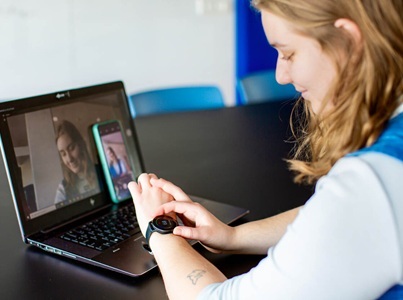
Subject in research setup. Credit: NFI
Deepfakes, manipulated videos of people, are a growing problem. Whether it concerns a famous Dutch person who has been edited into an existing porn video using Artificial Intelligence (AI), or a head of state who spreads harmful untruths in a fake video: the impact of a deepfake video can be enormous, both for the victim and for society—especially in a time of great (geo)political unrest.
That is why research into detecting deepfakes is more urgent than ever. During the European Academy of Forensic Science (EAFS) 2025, taking place May 26-30 in Dublin, Zeno Geradts, forensic digital researcher at the Netherlands Forensic Institute (NFI) and special professor of Forensic Data Science at the University of Amsterdam (UvA), presented an innovative method to distinguish real from fake in moving images: our heartbeat.
Due to the rapid technological developments in the field of deepfake AI, it is becoming increasingly difficult to recognize fake videos with the naked eye. The NFI is therefore investing in new methods of deepfake detection, so that it can also answer forensic questions about the authenticity of images in the future. At EAFS, Geradts presented a preview of a (not yet published) method to distinguish deepfakes from real images: blood flow detection.
Blood flow detection looks at the expansion and contraction of facial veins. Due to short-term vasodilation with each heartbeat, the amount of blood temporarily increases, which causes a subtle color difference that is measurable.
In deepfakes, this changing blood flow in the face is missing. The veins around the eyes, forehead and jaw are particularly suitable places to measure this dilation, because the blood vessels there are close to the skin.
"As far as I know, this is not used anywhere in forensic research. We are still working on the scientific validation, but it is a promising addition to the methods that already exist,” said Geradts.
Snuff movies
How Geradts came up with the idea is a remarkable story. Around 2012, the NFI was sometimes asked to do forensic research on so-called snuff movies: extremely violent films in which people are abused, tortured, raped and sometimes even murdered—whether or not staged. These types of films circulate on clandestine channels such as the dark web or encrypted platforms.
Geradts was investigating whether people in certain snuff films had actually died. At that time, he happened to come across a publication from the Massachusetts Institute of Technology (MIT), in which he read that researchers had discovered that you can measure someone's heart rate using the veins in their face.
"I knew right away that we could use this for image detection. That we had something in our hands,” said Geradts.
Patience
This method of heart rate measurement originates from the sports world. Over time, various techniques have been developed to measure heart and pulse rates, with the aim of registering and improving sports performances. This can be done, for example, by capturing electrical signals from the heart, or by measuring the subtle dilation of the pulse veins with each heartbeat.
“However, I could not immediately use the MIT research to develop a new method,” said Geradts. “The problem at that time was that image compression was not yet that good. All large image files are reduced in size so that they take up less space. With that reduction, the color difference that is visible with every heartbeat disappeared. But the compression techniques are also getting better and better, so that less image quality is lost. Thirteen years later, it is possible to measure that extremely subtle color change due to the increasing and decreasing blood flow.”
The research
Paula Pronk, a researcher at the NFI, set up the research into blood flow detection. This research was continued and expanded last year by NFI intern Sanne de Wit. She collected additional data and trained the model. Sanne completed her bachelor's degree in Computer Science at the Eindhoven University of Technology and is now completing her master's degree in Forensic Science at the UvA.
For the research, Sanne filmed test subjects who wore both a smartwatch and a heart rate monitor. She then compared the highly accurate measurements of these devices with the heart rate that was visible in the test subjects' faces.
To what extent did these measurements correspond? And what do you see when you compare these results with an AI-generated face? Sanne analyzed 79 points in the face where the color difference per heartbeat can be measured well. She did this in three different settings: one where the test subject was sitting still, one with a lot of movement, and one where there was little light on the face.
The data from her research confirmed that there were similarities between the measured heart rate and the color differences in the face under all circumstances. Professional literature also shows that these similarities can be observed with every type of skin color.
De Wit is now working on expanding the dataset and training an existing model.
Combining classical and innovative methods
Until the scientific publication, the method cannot yet be used for forensic research, but that is only a matter of time, according to Geradts.
“We have to keep looking for new ways to recognize deepfakes. Sometimes I worry that soon no one will believe in real images anymore. Everything will be seen as fake. What is true then?,” he said.
Geradts previously developed other methods for deepfake detection at the NFI, in collaboration with the UvA, such as Electric Network Frequency (ENF) and Photo Response Non Uniformity (PRNU). With ENF, you look at the flickering of the light in the video, the hertz signal, to determine when the video was recorded. PRNU analyzes the “fingerprint” of the camera, based on how pixels behave at a certain amount of light, to determine which camera the images came from.
The more classic (inspection) methods include looking for speech abnormalities, irregular blinking of the eyes or sloppily finished edges of a face after a so-called “face swap.” However, these edges are usually not visible with the latest AI models, because faces are no longer cut and pasted, but are generated entirely by AI. The chain of evidence is also examined: an overview of all the characteristics of the image material and the history of the file: who has done what with it? In addition, new AI detection algorithms are available every month that can serve as a tool.
"Combining and continuing to improve all these methods, that is our strength,” said Geradts.
Republished courtesy of NFI