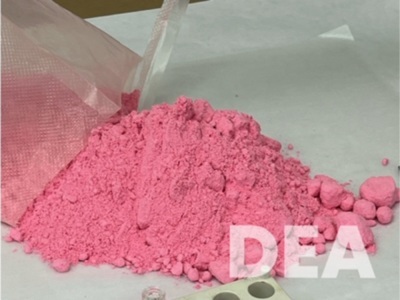
Pink cocaine has also been referred to as tusi. Credit: DEA
A new drug concoction that poses unique risks and has been heavily under-researched has made its way from Latin America and Europe to the U.S. recently.
“Tusi,” typically sold as pink powder and snorted, has been tracked in Latin America and parts of Europe as far back as 2018. Uruguay detected it in 2020; Switzerland, Columbia and Chile in 2021; and the UK and Australia in 2022. There are no statistics available for the U.S. as systematic drug checking data focused on Tusi in the states has been lacking.
Now, a new study from researchers at New York University and the Center for Forensic Science Research and Education estimates that—in 2024—2.7% of nightclub-attending adults in New York City used Tusi in the past year, with higher use among Hispanic people and people who use other drugs.
Drug background
Tusi is especially dangerous not only because little is known about the concoction, but also because there is confusion about the drug’s name, what it is and what it actually contains among those who use it and other drugs.
Tusi is commonly confused with the “2C” family of drugs, which are psychedelics, because it is a phonetic translation. Tusi is also called “tucibí” or “tusibí”—the phonetic translation of 2C-B, a particular type of psychedelic. It can also be called “pink cocaine”—cocaina rosada in Spanish. All of these names have the potential to confuse people who use.
Drug checking services in Latin America and Europe have found that Tusi rarely contains 2C drugs, rather it contains ketamine and a mixture of other drugs including MDMA, MDA, cocaine, methamphetamine, and more. In the U.S., a recent analysis of drug samples submitted for testing that were believed to be Tusi showed that almost all (95% of samples) contained ketamins as the main ingredient. Detection of MDMA was also common, whereas cocaine detection was relatively rare.
So, someone thinking they are taking the drug 2C-B may be expecting a minor stimulant and psychedelic effect—but they will actually experience the effects of ketamine, a dissociative anesthetic that induces feelings of detachment and can alter consciousness.
Very little data are available regarding the prevalence and use of Tusi in the United States. However, in January 2023, there was a seizure of 10 pounds of “pink cocaine” in NYC. Six months later, in June, there was a seizer of 140 pounds of Tusi off the coast of California.
“Information regarding the epidemiology of use is solely needed,” the study authors write in their recent article, published in Addiction.
New study, available data
Together, the study authors set out to estimate the prevalence of Tusi use among adults who attend electronic dance music at NYC nightclubs. The authors said they focused on nightclub attendees in NYC as it is a “high-risk population for party drug use who can serve as a potential bellwether for trends in the general population.”
Tusi use in this study was determined by self-report. The study surveyed a sample of 1,465 adults attending 124 electronic dance music events hosted by NYC nightclubs from January through November 2024. Participants took a survey on an electronic tablet before entering the nightclub.
Overall, an estimated 2.7% of electronic dance music nightclub-attending adults in NYC used Tusi in 2024, with higher use among Hispanic people and people who use other drugs.Compared with those who did not use drugs, those who used ecstasy 3.4-MDMA, ketamine, and/or 2C series in the past year were at higher odds for Tusi use. Compared with those not reporting Tusi use, those reporting past-year use were more likely to have saliva test positive for cocaine, ketamine, MDMA, methamphetamine and/or synthetic cathinones. Participants were also more likely to test positive for cocaine ketamine on methamphetamine after not reporting past-year use,
“People who use illicit drugs are often at risk of using drugs adulterated or even replaced by other drugs. But Tusi puts people who use drugs at an even higher risk—partly because Tusi is pretty much always a concoction of various drugs. This greatly increases the risk of adverse or unexpected effects,” said lead author Joseph Palamar, of NYU Grossman School of Medicine.