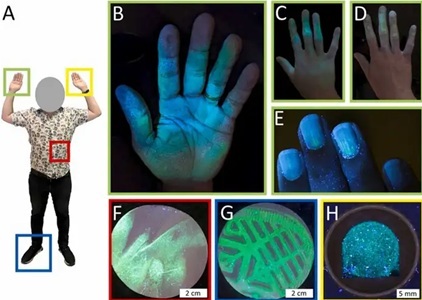
Assessing suspect involvement in shooting incidents. (A) Color marked areas for gunshot residue testing. (B) Direct lead testing on shooter’s hand showing bright green luminescence. (C) Lead testing on the hand of bystander after shooting showing moderate luminescence, and (D) weak luminescence after washing with water and soap. (E) Bystander’s hand after thorough washing still showing clear green luminescence on nails. (F) Indirect lead testing by wiping glass fiber cloth over clothing of a bystander shows bright luminescence. (G) Indirect testing of bystander’s shoe sole. (H) SEM stub after stubbing shooter’s hand showing green luminescence where lead is present. Image provided by AMOLF.
Researchers in Amsterdam have adapted a commercial lead testing kit into a method that can detect gunshot residue faster and more sensitively than current analysis.
When a weapon is fired, it leaves gunshot residue containing traces of lead in the surrounding environment, including on clothing and skin. Currently, police send all samples to the lab for analysis either with simple colorimetric reactions or sophisticated analytical techniques like scanning electron microscopy with energy dispersion spectroscopy (SEM-EDS). In general, ballistics analysis can be time-consuming, labor-intensive and require expensive equipment.
The new method builds off the work of Wim Noorduin and Lukas Helmbrecht, researchers at the University of Amsterdam. A few years ago, the duo developed an easy-to-use lead detection method based on perovskite technology. Perovskites are a promising material used in applications ranging from solar cells to LEDs.
The method uses a reagent to convert lead-containing surfaces into a perovskite semiconductor. When hit with a UV lamp, the newly formed semiconductor emits a bright green glow visible to the naked eye—making even small traces of lead easily detectable.
In 2021, Noorduin and Helmbrecht spun the technology out into a startup company that offers the test as a kit for users to check for potentially toxic lead in everyday items like paint, ceramics, dishes, children’s toys, cosmetics and more.
Now, Helmbrecht has developed an altered forensic version of the “Lumetallix” reagent: one that reacts especially well with lead atoms in gunshot residue and produces a long-lasting green glow.
In a paper published in Forensic Science International, Helmbrecht and team conducted a series of experiments to test the effectiveness of perovskite-based method. At a shooting range in Amsterdam, the team fired standard 9 mm full metal jacket bullets from two different pistols at cotton cloth targets placed at various distances. After applying a thin layer of the reagent to the cloths and illuminating with UV light at 365 nm, the results revealed well-defined bright green luminescent patterns that were visible to the naked eye.
The team also conducted presumptive testing for gunshot residue detection on “suspects” at the shooting range by swabbing hands, shoes and clothing with a modified non-toxic version of the reagent. As expected, upon spraying the hand of a shooter with the reagent, the researchers observed bright green on the entire hand. However, the team still saw green even after extensive washing of the shooter’s hands—which contrasts with current methods that cannot detect the lead particles after they are removed.
Additionally, bystanders within 2 meters of the shooter also tested positive with a clearly visible lead signal. After the bystanders “casually” washed their hands, the signal was moderate. Extensive washing and scrubbing still resulted in a weak signal, focused on areas such as the fingernails and skin creases on the backside of fingers.
“Unlike traditional GSR methods, [this method] still detects lead residues even after attempts to remove the GSR. Like the luminol test for blood, our method appears capable of detecting latent GSR traces,” the authors write in their paper.
Forensic experts with the Amsterdam Police are already testing the kit out at real crime scene investigations.
“We’re excited about the tests we’re conducting, and hopefully this will allow us to use the light-emitting method soon in actual court cases as evidence,” said Bente van Kralingen, a forensic expert at the Amsterdam Police.