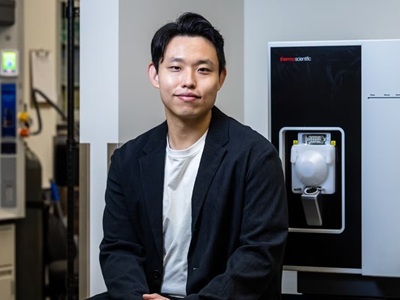
Min Jang, an assistant professor of forensic chemistry, is leading the development of a quick, simple and noninvasive method to detect drug use through fingerprints using an ambient mass spectrometer. Credit: Charlie Leight/ASU News
Collecting urine samples, blood or hair are currently the most common ways to detect drug use, but Arizona State University researcher Min Jang may have discovered something better—fingerprints.
“It is simple and noninvasive,” according to Jang, an assistant professor of forensic chemistry in the School of Interdisciplinary Forensics. “It can be done in 10 seconds.”
Jang’s work focuses on the chemical characteristics of latent fingerprints—fingerprints that may be on a glass or other surface. They aren’t necessarily apparent to the naked eye but can be made visible by dusting or fuming.
“The latent fingerprints are made up of sweat secreted by sweat pores,” Jang said. “When you analyze a drug that metabolizes, it contains inorganic and organic compounds from the metabolites of both the drug and the parent drug that are circulated through the bloodstream. Then they are secreted in multiple ways. Sweat is one of them."
Then the prints are put through a mass spectrometer, which confirms the presence of chemical compounds in the samples.
Jang has been developing this research for years. When he arrived at ASU's West Valley campus in fall 2024, he brought it with him.
So far, the method has been effective in identifying heroin and cocaine in a person’s body, but it also has applications beyond detecting drug use.
For example, it could help patients who need to take medicine on a regular basis.
“The fingerprint analysis can tell how long ago you took the drug and predict when you might need to take it again," Jang said.
He and his students will continue his work in his ASU lab, where a new mass spectrometer will be up and running by the fall semester.
Jang is also working with local addiction facilities to collect fingerprints from patients for substance-use testing, as the facilities are interested in the less invasive, less expensive way to perform drug testing.
And his expertise has implications for security, investigation and law enforcement needs.
“The ultimate goal of my research is always the same,” Jang said. “I always aim for practical applications with my developed method.”
Critical research
From creating a blowfly database to using shattered glass for ballistics, identifying hidden elder abuse, and analyzing DNA for animal conservation and criminal justice, ASU’s forensic program has experienced exponential growth in recent years.
In fact, the new School of Interdisciplinary Forensics at ASU’s West Valley campus is challenging the field of forensics, finding new innovative ways to solve crimes.
“There's a reason this research matters. It creates technologies, medicines and other solutions to the biggest challenges we face. It touches your life in numerous ways every day, from the roads you drive on to the phone in your pocket,” reads an ASU article.
The ASU research profiled here was made possible only because of the longstanding agreement between the U.S. government and America’s research universities. That contract provides that universities would not only undertake the research but would also build the necessary infrastructure in exchange for grants from the government.
That agreement and all the economic and societal benefits that come from such research have recently been put at risk.
Republished with information from ASU