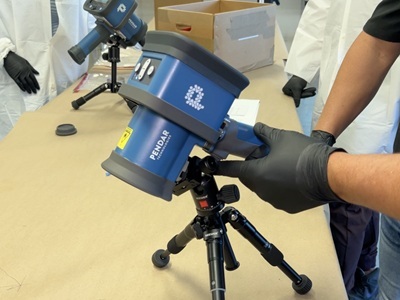
The FIU GFJC Drug Detect Pendar Raman spectrometer. Credit: FIU
Law enforcement officers across the country are facing an escalating challenge: new, more potent synthetic opioids that make overdose reversal harder and field drug identification riskier. A new initiative from Florida International University’s Global Forensic and Justice Center (GFJC) is stepping in to help.
The Academic-based Drug Field Testing and Training Initiative is designed to equip officers with more effective ways to identify dangerous substances like fentanyl and its analogs. Through a free, 45-minute online training course, GFJC teaches officers how to properly collect, preserve and analyze drug samples.
The need for advanced drug testing
The Omaha (Neb.) World-Herald recently reported that Omaha-area first responders are struggling to reverse overdoses due to carfentanil, a synthetic opioid that is significantly stronger than fentanyl. According to Douglas County Sheriff Aaron Hanson, carfentanil overdoses often require multiple doses of Narcan (naloxone) in order to be reversed. In 2023 alone, 33 people in Douglas County died from fentanyl overdoses.
Former Surgeon General Dr. Jerome Adams highlighted nalmefene as a stronger alternative to naloxone, but it is only available by prescription in Nebraska. While the FDA approved nalmefene in May 2023, medical experts warn against making it the primary overdose antidote due to the risk of severe withdrawal effects. In response to the crisis, the Douglas County Health Department is expanding Narcan access through vending machines to ensure broader availability.
As new and more potent opioids emerge, rapid and accurate drug identification is critical.
Testing in the field
Traditional field drug testing methods involve breaking glass ampules filled with chemicals, posing a contamination risk. Now, GFJC is introducing a handheld Raman spectrometer, a device that looks like a barcode scanner or radar gun. This tool allows officers to analyze substances without making direct contact.
"We use these handheld devices so officers never have to touch an unknown substance," a GFJC representative explained.
Training built for the real world
GFJC designed its training program in collaboration with law enforcement agencies across the country, incorporating firsthand insights from officers handling drug-related cases.
"We’ve learned a lot from officers about the types of cases they deal with every day," a GFJC spokesperson said. "That feedback has helped us refine both the training and the technology to make it as practical as possible."
As fentanyl and other opioids continue to evolve, law enforcement agencies need better tools to keep up. GFJC’s initiative is already gaining momentum, and there’s hope it will become a standard in police departments nationwide.
Law enforcement agencies interested in the training or learning more about field detection instruments can contact [email protected].