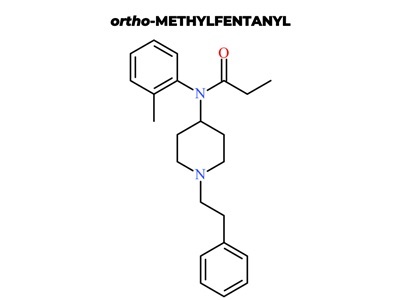
Credit: CFSRE
First detected in the Canadian drug market in early 2023, ortho-Methylfentanyl has now made its way to multiple states within the United States, according to a new public alert from the Center for Forensic Science Research and Education (CFSRE).
ortho-Methylfentanyl (oMF) is an active mu-opioid receptor agonist with potency similar to that of fentanyl. It bears structural resemblance to fentanyl and fentanyl analogues, such as para-fluorofentanyl.
The opioid is synthetically manufactured and can appear in three positional isomeric forms: ortho-, meta-, and para-methylfentanyl. The effects of oMF are similar to those of fentanyl, including analgesia, sedation, drowsiness, euphoria, etc., and in severe intoxication cases, respiratory depression and death.
Since initial identification, oMF has been confirmed in more than 200 forensic specimens originating from Canada and the United States. A majority of the cases were found in the British Columbia, Canada (182).
It is still the early days of detection and testing in the U.S., but forensic professionals have identified four specimens in California, one in Arizona and one in Massachusetts. Tests in Pennsylvania, Florida and West Virginia are pending.
In terms of co-positivity, oMF presents most often with fentanyl. Of 83 oMF samples tested, 70 had co-positivity with fentanyl. Analysts also found methamphetamine in 65 of those samples. THC and cocaine were detected in less than 15 of the 83 samples.
But it's not just “traditional drugs”—forensic analysts have also found co-positivity in the ortho-Methylfentanyl samples with other novel psychoactive substances (NPS). For example, para-Fluorofentanyl (ppF) was detected in 60 of the samples, while bromazolam was found in 55 samples.
pFF is a fentanyl analogue, and is considered a narcotic analgesic. Its use has drastically increased in recent years—3,019 reported blood cases in 2023 compared with four in 2016. Laboratory studies have shown it is approximately 3x less potent than fentanyl, however, concentrations in drug deaths suggest that deaths can occur with concentrations similar to those involving fentanyl.
Bromazolam is an illicit substance within the category of novel benzodiazepines, also referred to as synthetic benzodiazepines. According to the CFSRE, bromazolam made up just 4% of novel benzodiazepines in circulation in the drug market in 2021. However, in the first six months of 2023, bromazolam’s presence rose to an estimated 73% of the supply of novel benzodiazepines.
Data provided by CFSRE