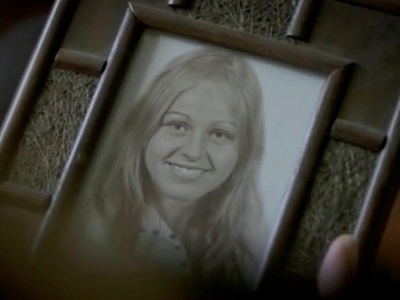
A photo of Betty Szabó. Credit: AmsterdamPolice
Investigators in Amsterdam have deployed a unique campaign to try to generate leads in the 2009 cold case murder of 19-year-old Bernadett “Betty” Szabó: a hologram of Szabó sits behind a window and asks for help.
Hungarian-born Szabó left for Amsterdam when she was 18 and started working as a prostitute in the Red Light District. She became pregnant during this period, but kept working throughout her pregnancy and started again shortly after her son was born.
On the night of Feb. 19, 2009, two fellow sex workers realized they hadn’t seen Szabó in her workroom on Oudezijds Achterburgwal, and they hadn’t heard the music she usually played either. At first, her colleagues thought that Szabó might have had a bad day or gone home early. But around 1:00 a.m., they decided to check her room. What they found was a horrific scene: Szabó lying dead in a pool of blood having been stabbed dozens of times. At three months old, Szabó’s son was now an orphan.
Police began their investigation immediately, combing the crime scene, studying camera footage and interviewing witnesses; but no leads were produced and the case went cold.
When the Amsterdam Cold Case Team looked at Szabó’s case again years later, they became convinced someone, somewhere knew something.
“Betty was murdered in one of the busiest areas in Amsterdam, maybe even in the Netherlands. It is really almost impossible that there are no people who saw or heard something unusual at the time. Or heard someone talk about the case, which doesn’t even have to have been in Amsterdam because, after all, the Red Light District gets visitors from all over the world,” said Anne Dreijer-Heemskerk, member of the Cold Case Team. “Fifteen years have gone by since. We hope witnesses who may have been afraid before or kept silent for other reasons now have the courage to come forward.”
That’s where the unique campaign came into play. From November 9 to 15, investigators deployed various methods in Amsterdam’s Red Light District to draw the public’s attention to the case. In one instance, a house near the crime scene was plastered with large stickers containing information about the case. Another house featured television screens showing the crime scene, the last images of Szabó’s before her murder, and a documentary.
The last element was the one likely to turn most heads: a life-sized hologram based on Szabó’s looks. In the window, the lookalike hologram sits on a stool trying to make contact with passersby—asking them for help. The holographic representation of the victim was using 3D visualization technology, something the Amsterdam police have never used before.
“We believe that Betty’s hologram may create a certain connection with her and thus convince a person to come forward. In this type of case, we always try to put a face to a victim so that informants know who they’re doing it for, and the hologram is a way of taking this a step further,” said Benjamin van Gogh, coordinator of the Amsterdam Wanted and Missing Persons Team, who is responsible for the campaign.
Additionally, the reward for information on the case has been raised to 30,000 Euro.
The Cold Case team and the Wanted and Missing Persons team said they hope the visualization of Szabó’s will generate widespread attention for the case, encouraging those with information to come forward.
“It is difficult to determine what it takes to get possible witnesses to share their information with us, explains van Gogh. “But we are committed to doing this with dignity, with relatives’ permission and with the clear purpose of achieving some form of justice for Betty by finding her murderer or murderers.”