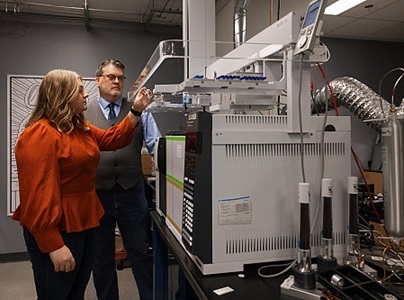
Alexis Hecker, a graduate student in the School of Science at IU Indianapolis, worked alongside Goodpaster on the case. Credit: Liz Kaye, Indiana University
A Michigan City, Indiana, man was sentenced over the summer to 65 years in prison for killing his roommate. A peculiar scent helped nail his conviction and introduced a new kind of evidence to Indiana courtrooms, thanks to Indiana University Indianapolis’ forensic science expertise.
It’s called the scent of death, and it’s composed of various chemical compounds emitted when a body decomposes. At high concentrations, its smell is akin to the aroma of cabbage, garlic, overripe cheese and decaying fish.
In 2017, John Hallett murdered his roommate, dismembered the body, left it to decompose in his basement and then disposed of the remains in a garbage can. Five years later, he called the Michigan City Police Department confessing to the crime.
It’s difficult for investigators to charge a murder suspect without a body. In the Hallett case, it’s likely that the victim’s remains ended up in a landfill. With no body, investigators had to determine whether there was once a decomposing body in Hallett’s basement. A corporal with the Michigan City Police Department called IU School of Science professor John Goodpaster to find out.
Before coming to IU Indianapolis, Goodpaster was a forensic scientist with the Bureau of Alcohol, Tobacco, Firearms and Explosives. His work is rooted in what he calls “chemistry for the public interest.” This guides his research interest, which is human hair, drugs, trace evidence and explosives analyses.
“Chemistry for the public interest is saying ‘What can we do with this work that has social value and is useful in a forensic application?’” said Goodpaster, a professor in the School of Science’s Department of Chemistry and Chemical Biology, and in the Forensics and Investigative Sciences program, both at IU Indianapolis. “We can point to a new technology or methodology we’re developing, but we evaluate if it’s going to have an application to forensic science, law enforcement or defense. It’s a real strong motivator.”
In the Hallett investigation, cadaver dogs had previously alerted the police to signs of decomposition in the basement. However, quantitative evidence was needed confirm. The department brought in fragments of the concrete floor where they believed the body was stored, as well as control samples from other areas of the floor. Goodpaster used GC-MS on the fragments. Within 24 hours, he found carboxylic acids compounds, consistent with decomposition, in some of the concrete samples. According to Goodpaster, the concrete had no noticeable scent, since several years had passed. However, in an effort to clean up, the suspect painted the concrete floors, which may have sealed the compounds in.
Before this case, scent of death evidence had never been used in Indiana. The most notable instance of this evidence used in a U.S. courtroom was during the Casey Anthony murder trial, in which the prosecution collected air samples from a car trunk that witnesses said smelled of human decomposition.
To introduce this novel evidence to the courtroom, Goodpaster and Michigan City police had to go through a Daubert hearing.
“The hearing took about an hour or so, and the judge decided that this is admissible,” Goodpaster said. “That set the precedent in the state of Indiana.”
IU Indianapolis Forensics Program
IU Indianapolis’ Forensic and Investigative Sciences program is known for its research advancing the field. The program is one of 54 accredited by the Forensic Science Education Program Accreditation Commission and the only program in Indiana. Several faculty work alongside law enforcement in matters that involve crime or the public.
For example, Susan Walsh, associate professor in the School of Science, conducts genetics research that can help law enforcement solve cold cases. In 2022, School of Science faculty members Christine Picard and Nick Manicke released a study that found that blow flies can be used as sensors in the detection of chemical warfare agents. Students graduating from the department have found employment with the FBI, Eli Lilly and Co., and various police departments and forensic labs across the country.
To maintain its accreditation, the department undergoes a rigorous review process every five years and must adhere to standards that ensures a strong scientific background for a forensic scientist.
“We stand out because we are accredited at the undergraduate and graduate level,” Goodpaster said. “There are different set of requirements for accreditation at each level, and we’re one of few that has both.”
Republished courtesy of Indiana University