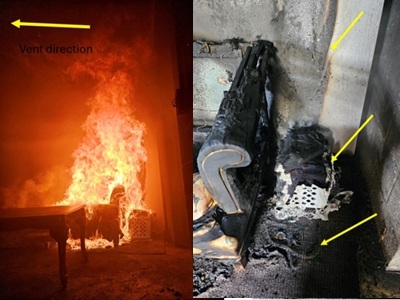
Single vent compartment test burn (left); and heat signatures on target fuels (right).
by Erik J. Mickelsen, IAAI-CFI, NAFI-CFEI(V)
Accurate origin determination involves a comprehensive analysis of the total compartment. Fire patterns and fire effects influenced by ventilation and flashover can mislead investigators, resulting in incorrect origin assignment. When ventilation dynamics and post-flashover fire effects are incorporated into the early evaluation of the involved compartment, these pitfalls can be avoided.
Analysis of fire development relative to the compartment fuel load during incident progression is a primary focus of investigators. Within the guidelines of the scientific method, hypotheses are developed and tested based on incident progression theories. These working theories are derived from many factors including the ability of the initial fuel package to transfer heat energy to target fuels and sustain propagation within the compartment. In most scenarios, convective heat transfer dominates the incipient stage development with radiative heat transfer becoming a more significant factor as the plume accumulates and the heat release rate increases. The signature effects of heat transfer through direct flame contact and radiative energy from the primary fuel package to secondary target fuels can be obscured by flashover, fire suppression activities, overhaul operations, structural collapse and other factors. These heat transfer signatures often survive the destructive impacts of the event and can be located, documented and evaluated successfully as evidence and geographic indicators of the origin. The challenge of this endeavor is the successful recognition and interpretation of these surviving signatures. Understanding the development of these heat transfer signatures is an important first step.
In the early stages of development, progression of flaming combustion away from the initial point of origin can be influenced by fuel characteristics and environmental conditions. Propagation depends on the preheating of remote sections of the initial fuel package. Continued successful propagation is dependent on a variety of factors including thermal inertia, fuel orientation, moisture content, and other material properties. In an uninhibited development scenario, the first fuel ignited may be significantly consumed. However, the signature of the initial combustion event cast onto contact target fuels and adjacent non-contact target fuels is less restrictive in the creation of an evidentiary imprint worthy of analysis. Depending on the characteristics of the target fuels, these imprints may include partial pyrolysis, localized melting and deformation, discoloration, staining, and limited mass loss displaying directional indicators of the initial heat source.
Identification of target fuel indicators and imprints are often a tedious and labor-intensive process. A critical step in this analysis is the accurate identification of the primary vent. Ventilation has a profound effect on flame front migration and plume movement, thereby significantly influencing the development of fire effects and fire patterns across the involved compartment. Documentation and analysis of directional flow path indicators relative to the primary vent will effectively assist the investigator with an accurate determination of the area of origin. Heat transfer and the progressive involvement of fuel arrays can be mapped across the compartment and will often correspond with the location and direction of the exhaust vent opening. Observed damage and deposition along the flow path may appear linear in nature.
The preliminary compartment analysis includes the systematic evaluation and documentation of fire, heat, and smoke patterns on windows, doors and other structural penetrations. A comparative damage analysis of interior and exterior openings should be conducted to document the incident impact on structural components. This examination can provide indications of fire, heat, and smoke exposure time, intensity, and duration. Weather data at the time of the incident can provide details of wind direction and speed which can influence fire pattern creation. The primary vent may not be an exterior opening; interior doors, wall penetrations or openings leading to oxygen rich areas may define the primary flow path. Development of a primary vent hypothesis, tested in accordance with our methodology should be compared to collected empirical data, scientific facts and research. Continued evaluation of the primary vent theory while processing your scene is imperative. Without a proper understanding of the ventilation impact on the compartment, the patterns observed cannot be accurately interpreted or analyzed.
The occurrence of flashover within a compartment creates a challenging environment for the analysis of fire effects and fire patterns. Although these scenes should be investigated with caution, they should not be accepted as indecipherable. In ventilation-controlled compartments, the cumulative heat effects of flashover can in fact be successfully analyzed, documented and interpreted. The lack of available oxygen may, in some instances protect and preserve the origin indication patterns on target fuels. As the environment becomes oxygen restricted, the reduction of flaming combustion may alter the impact of the event on the available fuel load. The appearance of low burn patterns can be incorrectly interpreted, especially within the post flashover environment. Investigators must analyze and interpret the thermal flux impact of post flashover temperatures on exposed combustible surface contents and separate these observed effects from those of the origin patterns and target fuel signatures. Variations in time and exposure can play a major factor in the successful navigation of this endeavor.
In a ventilated flashover event, heat exposure along the established flow paths may be more pronounced. Origin indication patterns on target fuels within this environment, located outside of the direct flow path, may remain in a semi-preserved state. Fuel packages within the flow path often exhibit more extensive damage directionally proportionate to the path of travel. Recognition of this damage gradient is essential to prevent the misinterpretation of ventilation driven damage as origin evidence.
In the controlled burn scenario pictured below, the evaluation of ventilation impacts on incipient stage heat transfer signatures and post flashover pattern development was observed. The first fuel ignited was a layer of cotton clothing near the top of the laundry basket. Ethyl alcohol was applied to the top layer of clothing, carpet and wall surface. An open flame was applied only to the top layer of clothing. The primary vent was a partially opened window located across the compartment.
During the incipient stage, the directional flame front movement towards the vent opening was less pronounced due to the available oxygen and size of the fire. As the heat release rate increased, the plume migration and flame front movement became progressively aligned with the vent path. The established directional flow path towards the vent initiated the involvement of the couch material, moving away from the initial ignition point. Heat transfer signatures on the initial target fuels remained preserved in a discoverable manner despite the developing fire. The carpet, manufactured to be resistant to flame spread in accordance with ASTM D2859, presented fire patterns consistent with short term exposure to a localized fuel and heat source. Melted remains of synthetic clothing material on the mid-levels of the laundry basket presented evidence of the early-stage heat transfer offering directional clues on the far side of the vent path. The heat signature on the gypsum board to the right side of the laundry basket are consistent with vertical plume migration prior to significant vent flow path impacts. This controlled burn scenario demonstrated ventilation influenced flow paths and their ability to distort and preserve origin patterns within a compartment.
The successful arrival at an accurate origin determination within a post flashover environment commands the integration of ventilation identification, flow path determination, heat transfer analysis and rigorous hypothesis testing. When the systematic approach is utilized and all data is gathered verified and tested, even complex scenes can yield reliable determinations and conclusions.
About the author
Erik J. Mickelsen, IAAI -CFI, NAFI-CFEI(V) is currently a Fire Marshal/Fire Investigator with the Franklin Township Fire Prevention Department. For the past 23 years he has been assigned to the Somerset County Prosecutor’s Office, Fire Investigation Unit. Additionally, Erik holds part-time positions as Chief Fire Marshal with the Bound Brook Fire Prevention Bureau and Adjunct Professor at NJIT specializing in fire/arson investigation.