co-authored by Peter J. Diaczuk, Ph.D., and Kelly Petersen
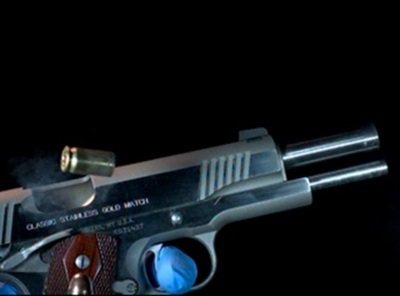
Law enforcement regularly encounters two primary types of handguns at shooting scenes—the revolver and the semi-automatic pistol. Both very common types of firearms are designed to discharge a projectile. However, the semi-automatic pistol can potentially leave additional evidence behind at the scene as the spent case is extracted and ejected from the firearm. These spent cases can be present at a shooting scene and become quite significant to investigators and crime scene personnel in their effort to determine where the shooting occurred, how far the shooter was from his/her intended or unintended target, and sometimes prove or disprove statements being made by victims, suspects, and witnesses. Various factors including ejection port location, type of pistol caliber and ammunition, the way the firearm is held, the surface upon which the spent case lands, and the caliber variations among pistols will impact the patterns created by the spent cases. This may also include the condition of the firearm (internal parts), the shooter’s grip on the firearm, and environmental conditions. This study focuses on the distance that spent cases traveled from the ejection port of various semi-automatic pistols to identify the shooter’s approximate position.
The location and type of spent cases recovered in a shooting scene may disclose important information pertinent to the approximate location of the shooter and will provide valuable details revealed on the headstamp1,2,3. The headstamp area on the case will produce a host of additional information as to the manufacturer/marketer, caliber, and type of firearm most likely used1. The possibility exits to obtain a deoxyribonucleic acid (DNA) profile and latent fingerprints from the handling of the cartridge case2,4. In addition, thorough microscopic examination by a trained forensic firearm examiner may reveal agreement necessary to link a particular firearm to recovered spent case evidence through comprehensive examination of breech face, firing pin, extractor, ejector, and chambering markings3,5.
Existing research has determined several significant factors relevant to influencing the final location of spent cases within the crime scene. These include the firearm design and condition, type of ammunition, position the firearm was held at discharge, environmental conditions, terrain, and the presence of intermediate objects6,7. An existing study also suggested that detachable magazine condition may contribute to spent case ejection8. Furthermore, existing research suggests how tightly the firearm is held may contribute and impact case disbursement9,10.
The location of spent cases in the crime scene can provide critical information to crime scene investigators. The position of the shooter may be increasingly difficult to estimate when little or no physical evidence is present in the scene8. While best efforts are made to collect all pertinent physical evidence to include spent cases it is noteworthy to mention that spent cases may be inadvertently kicked by suspects, victims, and witnesses within the shooting scene. In addition, they may be accidently moved unknowingly by law enforcement entering an active shooting scene1. Spent cases are potentially affected by the environment bouncing or rolling on conducive surfaces beyond point of impact11. Existing research suggested that the shooter’s stance when firing the semi-automatic pistol has no apparent impact on ejection patterns11.
The semi-automatic pistols used in this study were designed to use centerfire ammunition which consists of four primary parts: the case, the bullet, the propellent powder, and the primer. By design, the semi-automatic pistols utilized in this study will allow for the extraction and ejection of the spent case into the environment. This occurs as the energy produced at discharge recoils the slide to the rear allowing extraction and ejection of the spent case and affords a new unfired cartridge to cycle from the detachable box magazine into the chamber of the firearm. This process will repeat with each pull of the trigger with discharge until the shooter stops pulling the trigger, the firearm runs out of ammunition, or the firearm has a malfunction which inhibits the proper operation of the pistol. The proper cycling of the semi-automatic pistol at discharge allows for the spent case to enter the environment producing a valuable piece of evidence for crime scene investigators and the crime scene reconstructionist.
The current study utilized a series of 12 semi-automatic pistols consisting of four calibers (.25 caliber, .380 caliber, 9mm Luger, and .45 ACP caliber) and different bullet weights. A series of six cartridges were discharged from both a traditional firing method (left/position 1) and where the firearm was canted at ninety degrees counterclockwise (right/position 2) using the different brands and weights of ammunition during the experiment. The firearm positions are illustrated in image 1. This study was conducted on two surfaces to determine spent case terminal location using raked pea gravel and commercial grade carpet.
Image 1: Firing Position 1 (left)/ Firing Position 2 (right)
Image 1 denotes a traditional firing method (left/position 1) and discharging the semi-automatic pistol when canted at ninety degrees counterclockwise (right/position 2). The angle of the ejection port at discharge will impact the disbursement of spent cases into the crime scene environment. This notion is supported in existing research and was noted in the current study.
Numbered placards were used to document where the spent cases came to rest on the surfaces noted above and digital photography was utilized for documentation purposes. Each spent cartridge was discharged from a semi-automatic firearm resting on a tripod at a height of approximately 53 inches. This was incorporated into the study to ensure that each semi-automatic firearm was discharged at a consistent height to the surface area. A grid was produced and marked on the ground with an x and y axis creating four distinct quadrants marked with distinctive lines for documentation purposes. Each quadrant was further marked into individual one-foot squares for demarcation allowing for more precise measurements on the ground.
The study consisted of documenting spent case behavior using hand firing position 1 and position 2 on a gravel and carpet surface. Each of the 12 firearms were discharged six times using each hand position and surface as documented in figures 1, 2, 3, and 4. It should be noted that 10 of the 12 firearms had right side ejection ports with the remaining two as top ejection. The firearms with top ejection ports were isolated to two .25 caliber semi-automatic pistols significantly impacting the distribution of the spent cases in the controlled environment of this study. Those spent cases were distributed more sporadically on the grid. In general, the .25 caliber spent cases traveled further than all other ammunition used in this study.
It should be noted that when firing the semi-automatic pistols in the traditional firing position (position 1) the spent cases were largely documented to the right side and rear of the shooter on the grid as noted in figure 1 and figure 3. When firing the semi-automatic pistols in the modified or canted firing position (position 2) the spent cases were largely documented to the left side and rear of the shooter on the grid as noted in figure 2 and figure 4.
The shaded regions in figure 1 illustrate the general area in which the spent cases landed on the gravel surface for each caliber handgun used in the study when using a traditional firing method. The boundaries are denoted by the greatest distance traveled in both the positive and negative x and y directions, with the origin (0,0) representing the position of the ejection port. The arrow indicates the direction of discharge.
The shaded regions in figure 2 illustrate the general area in which spent cases landed on the gravel surface for each caliber handgun used in the study when using a firing method in which the firearm position was canted at 90 degrees. The boundaries are denoted by the greatest distance traveled in both the positive and negative x and y directions, with the origin (0,0) representing the position of the ejection port. The arrow indicates the direction of discharge.
The shaded regions in figure 3 illustrate the general area in which spent cases landed on the carpet surface for each caliber handgun used in the study when using a traditional firing method. The boundaries are denoted by the greatest distance traveled in both the positive and negative x and y directions, with the origin (0,0) representing the position of the ejection port. The arrow indicates the direction of discharge.
The shaded regions in figure 4 illustrate the general area in which spent cases landed on the carpet surface for each caliber handgun used in the study when using a firing method in which the firearm position was canted at 90 degrees. The boundaries are denoted by the greatest distance traveled in both the positive and negative x and y directions, with the origin (0,0) representing the position of the ejection port. The arrow indicates the direction of discharge12.
Generally, the .25 caliber cases traveled the farthest and more sporadically around the shooter in both positions, while the other calibers landed in a more localized area behind and to the right of the shooter when using a traditional firing method (position 1), and to the left of the shooter when the firearm is canted at ninety degrees counterclockwise (position 2). The way in which the handgun is held, and the location of the ejection port greatly influenced the ejection pattern, as can be seen when comparing figures 1, 2, 3, and 412.
This study was based on an ideal situation; the cases landed on a flat surface and were not influenced by any outside forces (run over, inadvertently kicked or moved, etc.). Even though two different bullet weights were used for each caliber handgun in these experiments (except the .25 caliber), no noticeable difference was noted in the spent case ejection pattern12. In addition to those other variables which may influence spent case distribution, the condition (frequency of use, recoil spring tension, damage, or corrosion) of the firearms may impact the spent case ejection pattern.
In a second experiment using carpet and both shooting positions, ejected cases produced patterns with a minimum distance of zero inches and a maximum distance of 17 feet 10 inches from the shooter. This study was based on handguns that were seized in crimes and were in a forensic firearm reference collection and varied in condition12.
About the authors
Andrew J. Winter, Ph.D., is currently a Sergeant at the Middlesex County Prosecutor’s Office supervising his agency’s Intelligence, Counterterrorism, and Bias Units. Dr. Winter has over 22 years of active law enforcement experience with over 18 years of collective experience in the special victim’s unit, homicide unit, crime scene investigation unit and in forensic ballistics. Dr. Winter has testified as an expert witness in forensic ballistics in New Jersey Superior Court and United States District Court in the Southern District of Manhattan. Dr. Winter holds a Ph.D. in Leadership with a concentration in Criminal Justice from the University of the Cumberlands.
Peter J. Diaczuk, Ph.D., is currently an assistant professor of criminalistics in the Department of Science at John Jay College of Criminal Justice. Dr. Diaczuk has been a presenting author on 134 presentations at regional and national forensic science conferences. Dr. Diaczuk has testified as an expert witness in forensic ballistics in both state and federal courts. Dr. Diaczuk holds a Ph.D. in criminal justice with a concentration in forensic science from the CUNY Graduate Center in New York.
Kelly Petersen, B.S., is a graduate of Centenary University with a B.S. degree in biology with a concentration in forensic science.
References
1. Pepper, I.K. and Bloomer, S.T. (2006). Cartridge casing ejection patterns from two types of 9mm self-loading pistols can be distinguished from each other. Journal of Forensic Identification. 56(5), 721-725.
2. Haag, L.C. (1998). Cartridge case ejection patterns. AFTE J. 30(2), 300-302.
3. Fisher, B.A. & Fisher, D. (2002). Techniques of Crime Scene Investigation, 9th ed. CRC Press.
4. Szibor, R., Michael, M., Plate, I., and Krause, D. (2000). Efficiency of forensic mtDNA analysis: Case examples demonstrating the identification of traces. For Sci. Int. 113(1-3), 71-78.
5. Warlow, T.A. (1996). Firearms, the law and forensic ballistics. Taylor and Francis. London.
6. Nishshanka, B. and Shepard, C. A. (2020). Forensic-based empirical study to analyze the empty case ejection patterns type 56 assault rifles. Journal of Forensic Sciences. 13(3), 1-9.
7. Lo, A. and Liscio, E. (2021). Determining the accuracy and errors of estimating a shooter’s position based on cartridge case ejection patterns. Forensic Science International.
8. Kerkhoff, W., Alberink, L., Mattjissen, E. (2018). Magazine influence on cartridge case ejection patterns with glock pistols. Journal of Forensic Science, 63(1), 239-243.
9. Hueske, E.E. (2006). Practical Analysis and Reconstruction. Elsevier Academic Press.
10. Lewinski, W.J., Hudson, W.B., Karwoski, D., and Redmann, C. (2010). Fired cartridge case ejection patterns from semi-automatic firearms. 2(3), 1-32.
11. Sims, E. and Barksdale, L. (2005). The importance of careful interpretation of shell casing ejection patterns. Journal of Forensic Identification. 55(6), 1-11.
12. Winter, A.J., Diaczuk, P., Petersen, K. and Walsh, J.W. (2017). Cartridge Case Ejection Patterns based on Bullet Weight, Caliber, and Firearm Position. Poster presentation at the International Association for Identification (IAI) Annual Educational Conference, George World Congress Center, Atlanta, GA.
Note: This article is not based on the opinions and/or views of the Middlesex County Prosecutor’s Office or any other form of state or county government.