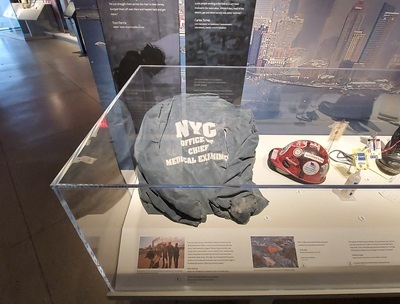
Brian's windbreaker that was lost after he was knocked unconscious when the South Tower fell. It was later recovered as proof of his "death." Credit: Brian J. Gestring
by Brian J. Gestring, Consultant, 4n6Services
Twenty-four years ago, I was part of a team that responded to the attacks on the World Trade Center. While that morning has shaped almost every aspect of my life since, I rarely talk about it. Last year I was persuaded to submit a brief piece for the AAFS news to highlight the perils forensic providers face by their constant exposure to the trauma of others. It was uncomfortable, but I’m starting to realize it is important for others to understand both the horrors and the heroism that occurred on that unseasonably warm fall morning.
Back in 2001, I was a supervisor in a crime scene reconstruction unit based out of the New York City Medical Examiner’s Office. When the first airplane hit the North Tower, I was sitting in annual Right-to-Know training. My cell phone started to vibrate. The next thing I knew I was in our unit’s truck speeding down 2nd avenue with three other team members. Emergency vehicles were descending on lower Manhattan from all parts and even though it wasn’t coordinated in advance, we soon found ourselves in a convoy of emergency vehicles flying down the West Side Highway, which had been closed off to normal traffic.
I was sitting in the back seat and out of instinct reached into one of our crime scene cases and took out a camera. I loaded a roll of film and started taking pictures. By then, both towers had been struck and the scene was horrific. Against the backdrop of the clear blue sky, thick gray smoke belched from both towers. I could see structural damage to the buildings spanning multiple floors, and as we got closer, flames were licking out of the South Tower. The last picture I took was as we approached West and Vesey Street before I put the camera away. We ended up parking the truck on Liberty Street just under the South Tower where we met up with some other responders from the Medical Examiner’s Office.
If you spend any time around the city, you get used to a level of background noise from lots of people living their lives in very close proximity. We exited the truck into an eerie silence. There was a low growl of diesel engines with an occasional squawking of a responders radio—and a strange tinkling that turned out to be shards of glass falling through the air. Every now and then, there would be a loud thump that sounded like an exploding water balloon. It took a second for me to realize that those thumps were jumpers. As I looked up, I saw a jumper and felt like I made eye contact with them. Some people say that once someone jumps from a building they are no longer conscious of the fall. I saw a lot of jumpers that day and I don’t believe that for a minute. The horror they transmitted to me in those brief milliseconds will never leave me.
It soon became clear that we were not in a safe spot. Since communications were spotty at best, I started to walk to the fire command post located in the base of the North Tower to find out where they wanted us to relocate. As I was walking north on West Street, the South Tower started to collapse. I frantically looked for cover. The only thing I could find was a ladder truck that was parked before a pedestrian overpass just south of West Street on Liberty. My plan was to dive under that truck. To this day, I don’t know if I made it. I briefly remembered looking up and then everything went black.
I was found unconscious on a rail down by the North Cove Marina by a New Jersey State Police boat. I have no memory of how I got from where I was knocked out to the North Cove Marina, which was about ¼ mile walk. My first memory was a rumbling feeling, being in a vertical position, and a French Blue sleeve to my left, then I was out of it again.
As fate would have it, even though we weren’t together when the South Tower collapsed, the three other members of my team were all evacuated on the same boat to New Jersey and met up as we were being helped off the boat. I had apparently been propped up in the captain’s chair of the boat next to the helmsman. I don’t remember walking off the boat or sitting on a ledge waiting to be treated and transported by EMS, but I do remember the pain. The back of my head was open to the skull, I had glass and metal in my eyes and I had a laceration on the top of my right hand with exposed tendons.
Arrangement of World Trade Center buildings at the site pre-9/11. In this map, WTC 1 is the North Tower, WTC 2 is the South Tower and WTC 3 is the Marriot Hotel.
Once I was moved into an ambulance, I struggled to remain conscious. As I pulled into the ER, I was able to tell them my wife at the time’s phone number and someone was able to reach out to her. Carol picked up my mother and they both drove to the hospital.
Up until this point, I thought I knew pain, but that was when they decided to take my contact lenses out around the glass and metal debris stuck in my eyes. Even though I was the most seriously injured patient they had seen so far, the hospital thought that worse were coming, and quickly moved me to a floor where I was left unattended. At some point, Carol and my mother managed to find me.
I was fortunate because I came from a resourceful family. Carol is a nurse and was the first to treat me. She started an intravenous line and started giving me fluids while she did a patient assessment. My brother Craig was in Illinois at the time, but was coordinating getting people and resources to the hospital. My brother Mark is a trauma surgeon and his wife Holly is a Physician’s Assistant. Craig notified Mark and Holly, and they both grabbed supplies, jumped in a car and drove down from Rochester, NY. Carol called two more friends, Lisa Bonin who is a Physician’s Assistant and Stephanie Reynolds, who is a nurse. They all grabbed supplies and headed for the hospital.
As strange as it sounds, the first doctor to treat me was my brother Mark who drove down from Rochester. Right in the hospital room, my private medical team set up an operating theater and started putting humpty dumpty back together again. I felt like a thanksgiving turkey with everyone working on different parts of me at the same time and I told them so. After a brief pause, they looked at each other and chose to ignore me.
After I was stabilized, the hospital staff inserted themselves back into my care. I can’t really fault them for abandoning me. They were triaging as they knew how. I was still breathing, and they were keeping their resources available for the wave of more seriously injured that everyone was expecting. Who knew that you either got out early or you didn’t get out at all. I can’t imagine what it must have been like for them to just keep waiting.
I had several more eye surgeries to remove glass and metal from my eyes. During the majority of my stay in the hospital my eyes were either bandaged closed or so packed with a gel-like vaseline that I couldn’t see anything. This is one of the reasons that I didn’t fully understand the extent of my injuries.
As soon as I could see, I realized that I couldn’t read. I also lost my short-term memory. While these are all common side effects of a traumatic brain injury, they were unwelcome news to me. My colleagues joked, “I thought mom said you can’t take away a college education,” but I was really terrified. It was clearly a case of you don’t really appreciate something until you lose it.
The further I got out from my hospital stay, the more problems were identified. I needed physical therapy for an ankle injury that I didn’t know about until I was vertical. I needed cognitive therapy once I realized the effects of the traumatic brain injury. I also still needed additional treatment for my eyes and other wounds.
My recovery took a while, but I never lost sight of the fact that I was one of the lucky ones. I had worn a windbreaker when we initially got down to ground zero. It was lost after I was knocked unconscious. My name was written in sharpie on the inside and the torn and bloody windbreaker was later collected as proof of my death. The windbreaker has been on display at the World Trade Center Tribute Center since 9/11, and has now been moved to the New York State Museum for the new exhibit they are planning for the 25th anniversary. Our brand new Ford Excursion was crushed under the rubble of the South Tower. The only thing left of it now is the damaged driver side door on display in the 9/11 museum.
The Ford Excursion Brian and his team drove to the Towers that morning was crushed under the rubble of the South Tower when it fell. The only thing left of it now is the damaged driver side door on display in the 9/11 museum. Credit: Brian J. Gestring
When I returned to work still on crutches, I hobbled by the large plywood boards covered in posters of the missing outside Bellevue Hospital multiple times a day. It was hard to escape the horror of that morning, but it was equally hard to forget the unparalleled heroism that I witnessed. Even though I was taken out of the game relatively early, I still saw people of all races, creeds and colors risking their lives to help people they didn’t even know.
People made the ultimate sacrifice that day, and some are continuing to make that sacrifice today as their bodies are ravaged by World Trade Center-related illnesses. This is one of the major reasons I decided to tell this story. There are tens of thousands of stories that are more compelling than mine. As a nation, we can’t turn our backs on those that put the needs of others before their own. Please contact your congressman to protest the firings of those managing the World Trade Center Health Program program and implore them to fully fund the World Trade Center Health Program.
On a personal note, I will be forever grateful to my personal medical team. Craig who seamlessly coordinated a comprehensive medical response from four states away. Carol who was the first to treat me and put up with me through a long and difficult recovery, driving me everywhere. Mark and his wife Holly who are responsible for me still being able to use my right hand, and Lisa Bonin and Stephanie Reynolds, who made sure that my skull wasn’t on permanent display.
I also can’t thank the Troopers enough—Joseph DeMarino, Alex Koopaletes and Clark Motley—who found me at the North Cove marina and transported me to safety, even if it was to New Jersey. Initially, I wasn’t clear on how I ended up in New Jersey, but after combing through news footage and doing a little investigating, I was able to track them down and thank them in person.
While I solve mysteries for a living, I have yet to solve the mystery of how I got from under the collapsing South Tower to the North Cove Marina. Some speculate that I might have walked that last ¼ mile on my own, but given the shape that the Troopers found me in, I think that’s unlikely.
Even 24 years later, I’m still on the case. I keep going through any footage I can find of that morning paying specific attention to right after the South Tower went down. At some point I’ll find a clue. It will lead me to who helped me get out, and allow me to thank them. If they didn’t make it out, then I’ll track down their children and let them know that their parents’ sacrifice meant something.
Brian put a video together back in 2001 of the images and videos he was reviewing. He never shared it in 200, but posted it on YouTube to coincide with the 24th anniversary of the attacks.
About the author:
Over the past 30+ years, Brian has held nearly every role from scene investigator to Director. As a practitioner, he has worked at, supervised, and managed some of the largest and busiest crime labs in the country. As an academic, he has taught undergraduate and graduate coursework, conducted research, and Directed a University Forensic Science program. He consults in all areas of forensic practice and focused on ways to improve the reliability and resilience of forensic practice.