co-authored by Peter J. Diaczuk, Ph.D., and Katherine M. Seggel, M.S.
Blank (imitation) guns can appear remarkably realistic. Many blank guns resemble authentic or real firearms, however blank guns are not designed, at the time of manufacture, to discharge a projectile from the barrel. In fact, many of these barrels are sealed or plugged, the chamber may be designed shorter so not to allow a cartridge of real ammunition to seat properly, and vent holes are sometimes located on the barrel and slide to disperse the energy that results from discharging a cartridge (preventing this energy from being dispersed from the muzzle or end of the barrel). Blank ammunition is designed with a case, propellant, and primer but no projectile. When discharged, the blank cartridge has the potential to produce a flash, an explosive sound, and in many cases the blank gun cycles in similar fashion to an authentic firearm. Blank guns are also sometimes referred to as imitation guns, starter guns, or even prop guns. We examined two blank firing guns (semi-automatic pistol and a revolver) and two authentic or real firearms (semi-automatic pistol and revolver).
Blank or replica guns can be visually identical in appearance to authentic or real firearms1. In a previous study, law enforcement officers, when presented with a variety of authentic and replica guns were most accurate at visual identification to distinguish real from fake, but only at a 50% accuracy1. In the real world, there is largely like-minded agreement that police officers responding to incidents involving firearms must always assume the gun is real and not a replica or blank gun1. For distinction purposes, blank or replica guns are designed to discharge blank ammunition consistent with that of a prop gun or starter pistol where the ammunition is constructed with no projectile seated in the throat of the cartridge2.
A cartridge of ammunition designed to be discharged from an authentic firearm would consist of a projectile that upon discharge would engage the rifling, race through the barrel, and exit from the muzzle or end of the barrel and into the atmosphere. Blank guns are designed and produced largely for entertainment and sporting purposes2,3. The reality is that many with criminal intent use blank guns simply based on ease of accessibility, low cost, and for the authentic appearance to that of a real firearm for nefarious purposes. In the United States, in year 2024, there were 12 individuals killed by police officers while in possession of a blank or replica gun4. Three of those 12 killed through police officer interaction were minors3.
It is important to note there is a distinction between replica and toy guns3. Toy guns are typically distinguished by the manufacturer with bright colors to the frame and muzzle, which has been regulated for years3. Often, criminals do make efforts to modify toy guns to appear more like a real or authentic firearm. However, by design there is some regulation required to delineate a real from a toy gun3. That said, replica or blank guns are not bound by the same rules and mandatory demarcations3. The lack of regulation means blank, or replica guns are often produced to appear as real firearms from the manufacturer3. This makes active identification in the street more difficult for law enforcement personnel during active encounters.
Police officers are forced to make split second decisions daily in small towns and urban cities all over the United States. In those most unfortunate and dangerous armed interactions sworn law enforcement officers must decide whether to shoot or not to shoot in suspect weapon encounters. Those split-second decisions may be the difference between life and death of the police officer, suspect, and/or a victim.
Image 1: Blank EKOL semi-automatic pistol (left)/Blank Bruni Magnum revolver (right).
This research utilized two blank guns; one a semi-automatic blank pistol (model EKOL) and the other a revolver (model Bruni Magnum) illustrated in Image 1. Two authentic firearms were also used for comparison purposes; one semi-automatic pistol (Beretta model 92FS) and one revolver (Smith & Wesson model 586-1) illustrated in Image 2. Two sound meters were used as well as a Phantom V711 high-speed camera to document and record the data points. The blank guns (image 1) and authentic or real firearms (image 2) used in this research were of similar appearance, design, size, and configuration as illustrated in image 1 and image 2. The guns used in this research were all discharged from the same height for conformity and in similar weather conditions.
Image 2: Real Beretta 92FS semi-automatic pistol (left)/Real Smith & Wesson 586-1 revolver (right).
The authentic firearm used in this research study was designed to discharge centerfire ammunition, which is considered to have four main components to include the case, projectile, propellent and primer. Ammunition characteristics may differ; however, the centerfire ammunition anatomy and morphology will consist of these four primary components.
Blank ammunition is designed in a similar fashion and includes the case, propellent, and primer, but will not contain, by design, a projectile seated in the throat of the cartridge case. The lack of a projectile is the primary differentiation, and, by design, what delineates this as blank ammunition from real ammunition in terms of the major components of the cartridge. In addition, there may be differentiation in propellant morphology.
Equally important to note is that in both authentic and blank ammunition the discharge will be initiated with an impact of the firing pin or striker to the primer sending a flash through a flash hole designed to ignite the propellent. In authentic firearms, this ignition of the propellent is the fuel needed to send the projectile into motion, down the barrel of the firearm, and into the atmosphere. In blank ammunition, the ignition point is similar; however, in absence of a projectile the designed blank ammunition will simply sound like an authentic or real firearm. In addition, real and blank guns will release gases as the propellent is fully or partially consumed on discharge.
The blank ammunition used in this research study was single based powder (RK) in the blank revolver and double-based powder (PAK) in the semi-automatic blank pistol. Typical propellent for authentic pistols and revolvers is double-based in nature. Both the .38 Special caliber and 9mm ammunition used in this study was double-based powder. This was examined by manually disassembling a sampling of blank and authentic ammunition cartridges to retrieve the propellent for observation under a stereo microscope in the forensic laboratory.
Image 3: .357 caliber S&W 586-1 revolver at discharge (left)/9mm Beretta pistol at discharge (right).
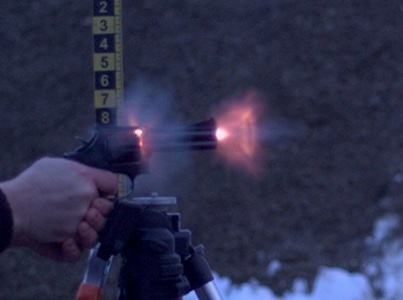
The current research was captured using high speed photography as illustrated in image 3 and image 4. Image 3 captures the .357 caliber Smith and Wesson revolver, model 586-1 (left), and the 9mm semi-automatic Beretta pistol, model 92FS (right), at discharge. It is noteworthy that both high speed photographs (image 3) depict burnt and unburnt propellent forced with the projectile down the barrel, exiting the muzzle of the respective firearms and into the atmosphere. This is expected on the discharge of authentic or real firearms and may result in what we refer to as gunshot residue patterns (GSR) based on a variety of factors to include proximity to target and shooter. In addition, image 3 (left) of the revolver illustrates additional flash noted at the front of the cylinder referred to as the cylinder gap (small space between the cylinder and the barrel’s forcing cone) as the projectile travels from the cylinder across an airspace into the forcing cone to engage the rifling of the barrel. This is a very common notation on the discharge of an authentic revolver.
Image 4: Blank revolver (Bruni Magnum) at discharge (left)/Blank pistol (EKOL) at discharge (right).
The research shows there is a clear differentiation between the authentic firearms and blank guns. Please note, image 4 does not depict the expulsion of burnt and unburnt gases at the muzzle end of the barrel as it is capped by design in unmanipulated blank guns. That said, the gases produced at discharge are released and expelled as shown in image 4. Image 4 (left) illustrates what appears to be a greater volume of flash expelled from the blank revolver in the area in front of the cylinder in what is referred to as the cylinder gap. Image 4 (right) is fundamentally noteworthy as the expelled gases are released from vent holes in the slide of the blank semi-automatic style pistol creating a unique visual display pattern. Again, no release of spent gas at the muzzle end of the blank gun barrel by design.
The current study clearly establishes that blank guns can visually resemble authentic firearms and can be easily mistaken prior to discharge on appearance alone as illustrated in image 1 and image 2. In many ways, blank pistols resemble authentic firearms at rest and at discharge. The blank revolver design functions the same way with a rotating cylinder (clockwise or counter-clockwise by design) and both the blank and real revolver produce a visual display of gases at the cylinder gap area. In addition, the hammer functions the same way in both single and double action to mimic an authentic revolver firearm. In the semi-automatic blank gun examined, the hammer also functions in single and double action, the slide retracts to the rear on discharge, extracting and ejecting a spent case from the ejection port and into the environment. The slide then retreats forward loading another blank cartridge into the chamber mimicking the cycling procedure of an authentic firearm. The blank semi-automatic pistol also accepts and seats a detachable box magazine identical to that of a real firearm. The main difference is that, by manufacturer design, the blank gun cannot discharge a projectile as the muzzle is capped and produced gases (flash) are vented from the slide instead of from the muzzle or end of the barrel. Based on the design of the blank semi-automatic pistol these venting ports may be located on the top or sides of the slide to allow the gases to escape. However, it is worthwhile noting that blank guns have been manipulated or altered by their owners to allow a projectile to discharge from the blank pistol or revolver creating another layer of complexity and risk for law enforcement personnel.
While the decibel versus distances demonstrated a difference using a sound meter, it is not reasonable that the human ear could make that distinction at discharge4. Clearly, the most noteworthy distinction is a visual one captured with photography depicting the flash and escape of gases which may make it easier to delineate blank from real firearms4. However, it is not likely or easily differentiated in an active shooter situation. A flash is produced on the discharge of a blank gun mimicking a real firearm, even though in the blank gun it may not originate from the end of the barrel. A law enforcement officer would have little time to make this delineation in an active situation especially when it has been established that blank guns often visually resemble authentic firearms and some may have been modified illegally to discharge a projectile. It would be unreasonable to expect a police officer or the public to make this distinction in a matter of seconds in a life-or-death situation.
About the authors
Andrew J. Winter, Ph.D., is currently a Sergeant at the Middlesex County Prosecutor’s Office supervising his agency’s Intelligence, Counterterrorism, and Bias Units. Dr. Winter has over 22 years of active law enforcement experience with over 18 years of collective experience in the special victim’s unit, homicide unit, crime scene investigation unit and in forensic ballistics. Dr. Winter has testified as an expert witness in forensic ballistics in New Jersey Superior Court and United States District Court in the Southern District of Manhattan. Dr. Winter holds a Ph.D. in Leadership/Criminal Justice from the University of the Cumberlands.
Peter J. Diaczuk, Ph.D., is currently an assistant professor of criminalistics in the Department of Science at John Jay College of Criminal Justice. Dr. Diaczuk has been a presenting author on 134 presentations at regional and national forensic science conferences. Dr. Diaczuk has testified as an expert witness in forensic ballistics in both state and federal courts. Dr. Diaczuk holds a Ph.D. in criminal justice with a concentration in forensic science from the CUNY Graduate Center in New York.
Katherine Seggel, M.S., is a graduate of Centenary University with a B.S. degree in biology with a concentration in forensic science. She also holds an M.S. in investigations from the University of New Haven.
References
1. Taylor, I. & Hornsby, R. (2000). Replica firearms: A new frontier in the gun market. Department of University of Durham and Gun Control Network.
2. Ognuc, G.I., Ozer, M.T., Coskun, K. & Uzar. A.I. (2009). Modified blank ammunition injuries. Forensic Science International. Vol. 193(1-3). https://doi.org/10.1016/j.forsciint.2009.09.021
3. Kutz, A. (2024). Police have killed 12 people holding replica guns this year. News Nation. https://www.newsnationnow.com/crime/replica-guns-shooting-police/
4. Winter, A., Diaczuk, P., O’Connell, K., and Law, X.S. (2019). Split Second Decision – Is It Real Or Is It Fake? Poster presentation at the American Academy of Forensic Sciences (AAFS) Annual Scientific Meeting, The Baltimore Convention Center, Baltimore, MD.
Note: This article is not based on the opinions and/or views of the Middlesex County Prosecutor’s Office or any other form of state or county government.