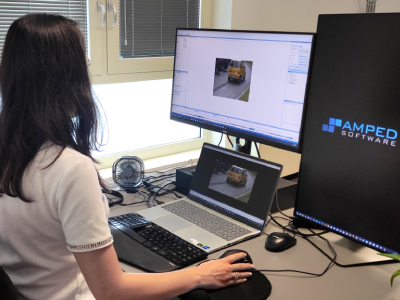
By Melissa Kimbrell, Trainer and Technical Support Specialist at Amped Software
In today’s interconnected world, nearly everyone is captured on some kind of video during their daily routines. Whether it’s through the lens of a surveillance camera, a smartphone, or a dashboard camera, the omnipresence of recording devices has had a huge impact on investigations. When it comes to identifying evidence from a crime or accident scene, it is important to consider all possible sources from which the incident might have been visually captured. Once those sources are identified, it’s of tantamount importance to properly collect the footage to retain the highest evidentiary value.
While Closed Circuit Television (CCTV) cameras might have historically been limited to businesses or public spaces, advances in technology have made these systems much more accessible to implement in urban and suburban areas. Drive down any neighborhood street and you’ll likely see video doorbells. Stop at a traffic light and you might see traffic cameras mounted atop the traffic signals. Constant improvements to smartphones and their embedded high-definition cameras have also increased the amount of witness-captured incidents. Additionally, many law enforcement agencies have embraced the utility of video evidence by mandating the use of in-car camera recordings as well as body-worn cameras to enhance transparency and accountability. These recordings also contribute valuable evidence in investigations. This article aims to provide a framework so that any technician can maintain the best evidence from the crime scene to the courtroom.
A Stable Foundation
The ubiquity of video around us may lead many to believe it is easy to collect this important piece of the puzzle. In reality, the evidence should be taken seriously and those performing video evidence collection should require a demonstrated competency prior to performance in the field. Without the proper technical skills as taught by organizations such as the Law Enforcement & Emergency Services Association (LEVA), investigators risk wasting time, misdirecting investigations, or invalidating the evidence for use in court. A stable educational foundation for collecting video evidence begins with a firm grasp of best practices in the industry. Organizations like the Scientific Working Group on Digital Evidence (SWGDE) publish documents with the goal of standardizing industry practitioners in topics such as proper acquisition, processing, handling, and presentation of evidence. Additionally, annual training symposiums and conferences through organizations like LEVA or the International Association for Identification (IAI) can provide invaluable opportunities to learn from other examiners and network with similar professionals. Furthermore, Essential Concepts and Principles for the Use of Video Evidence for Public Safety and Criminal Justice, a document written by Martino Jerian, CEO and Founder of Amped Software, outlines general concepts and principles to assist the law enforcement community, legal representatives, and governmental stakeholders in establishing a firm basis for the handling and processing of video evidence.
Previewing the Scene
Just as one would search a scene visually for friction ridge detail or trace evidence, the same type of visual inspection should take place for video evidence. It is important to consider the cameras within the immediate scene area and also those in the vicinity of the scene. The points leading up to and away from a scene can establish the presence of individuals or items at the scene, as well as assist in discerning context or intent. This footage can help to complement physical evidence items and witness testimony in offering a complete narrative around an incident. Video can provide an unbiased, objective record of events, which can assist the trier of fact in having a full understanding of the incident.
While some recording devices might seem obvious, others may require more effort to identify or locate. True investigation of the sequence of events can uncover new avenues in which to pursue video documentation.
Video Collection Processes
Once the items are identified, a careful understanding of how to properly collect this evidence is critical. When it comes to CCTV, physical access to the recording system can be a significant hurdle. Some businesses do not have local access to footage and it must be requested from a remote location. Some homes do not have locally stored video and the footage must be acquired from cloud-based storage. Many times, even after accessing the relevant system, a video may be protected by a password that is either unknown or withheld from investigators. Once access is gained, the examiner must be someone who adequately understands how to operate the device, how to navigate the system, and how to extract the relevant footage without causing any changes to the data itself. Video is essentially a visual representation of mathematical functions, therefore the collection of this type of evidence requires proper education and training. The CCTV Acquisition Blog Series by David Spreadborough, forensic analyst at Amped Software, thoroughly explains the process from video identification through viewing the acquired video evidence.
The next potential issue to overcome is a possible time discrepancy between the recording system and accurate real time. Documenting this offset is extremely important in assuring the proper period of video is extracted from a device. In many situations, a recording device will proceed to overwrite existing video data after a certain period of time. Therefore, improperly identifying the relevant video might result in the total loss of this potential evidence.
Evaluating Video Evidence
Once the initial acquisition stage is complete, the forensic expert faces a new set of challenges during the processing phase back in the office. These challenges include identifying image issues and their causes, which can be complex and multifaceted. The examiner must carefully analyze the footage to detect any artifacts or distortions introduced during the recording and acquisition process. This step is crucial for ensuring the integrity and reliability of the evidence. Additionally, the expert must employ appropriate scientific workflows to process the files accurately. Applying appropriate filters in the correct order is essential to avoid further degradation of the video quality. These challenges highlight the importance of a meticulous and scientifically validated approach to video evidence processing, which is critical for maintaining the evidentiary value of the footage in legal proceedings.
Current buzzwords around video evidence such as “deepfake” or “AI” lead to questions about video integrity and authenticity. To ensure the admissibility of video evidence in court, it is essential to maintain and properly document both aspects. With proper documentation, most concerns of integrity and authenticity can be defended in court, but some questions can arise, particularly when the evidence has been provided by witnesses or the general public.
Evidence authenticity refers to the video depicting what it purports to show. Common challenges to video authenticity include questions of accurate context, verification of the source of the imagery, verification of the integrity, and analysis of the visual data to analyze for processing or tampering.
The context from which a video is taken can cause misinterpretation by the viewer if not handled appropriately. Suppose the scene or physical evidence do not support the conclusions made by the video alone. In that case, it is important to consider all of these factors in determining the helpfulness of the video in understanding the ground truth of an incident. Identifying the source of video evidence can help to bolster authenticity, especially when the origin is unknown such as with anonymously submitted witness video.
Integrity refers to the state of the video evidence being unchanged since its original recording. Mishandling the collection of video can alter any number of things about the video, including but not limited to color space, aspect ratio, and frame rate. Any of these changes can dramatically affect the interpretation of the evidence. Physical evidence integrity can be documented by a chain of custody. The integrity of the video data can be maintained by proper collection of the evidence by a properly educated practitioner following best practices and local policies.
Some steps can be taken to maintain the best quality and prove originality, making clear that the evidence has been unchanged since the time of acquisition. For example, technicians can use newly formatted flash drives to acquire files, make sure they are as original as possible, and then apply a digital signature (known as a hash) to the file. These steps apply a foundation for admissibility. An experienced and knowledgeable examiner can later assess evidence for the presence of tampering or processing by examining the data, file structure, and pixel information.
Provenance and Authentication Provides Clarity for the Investigators and the Courts
In conclusion, the prevalence of video evidence at incident scenes represents a huge advancement in contemporary investigations, offering unprecedented insights and clarity into events. Not only can we analyze these scenes in a different way than can be completed with purely physical evidence, but we can better provide the trier of fact demonstrative evidence to help in ascertaining guilt. If the footage itself is not properly handled, however, the admissibility and overall effectiveness of the video can be severely diminished. By leveraging technological advancements and embracing best practices, examiners can harness the full potential of video evidence while mitigating inherent risks and challenges.
About the Author: Melissa Kimbrell has been a member of the Amped Software team as a Trainer and Technical Support Specialist since May 2022. She teaches both online and in-person and is always available to help users understand a proper workflow to process their video evidence. Melissa is a Certified Forensic Video Examiner through the International Association for Identification (IAI), a Certified Forensic Video Technician through the Law Enforcement & Emergency Services Video Association (LEVA), and a member of the Video and Imaging Technology and Analysis Subcommittee of the Digital Multimedia Scientific Area Committee (OSAC).